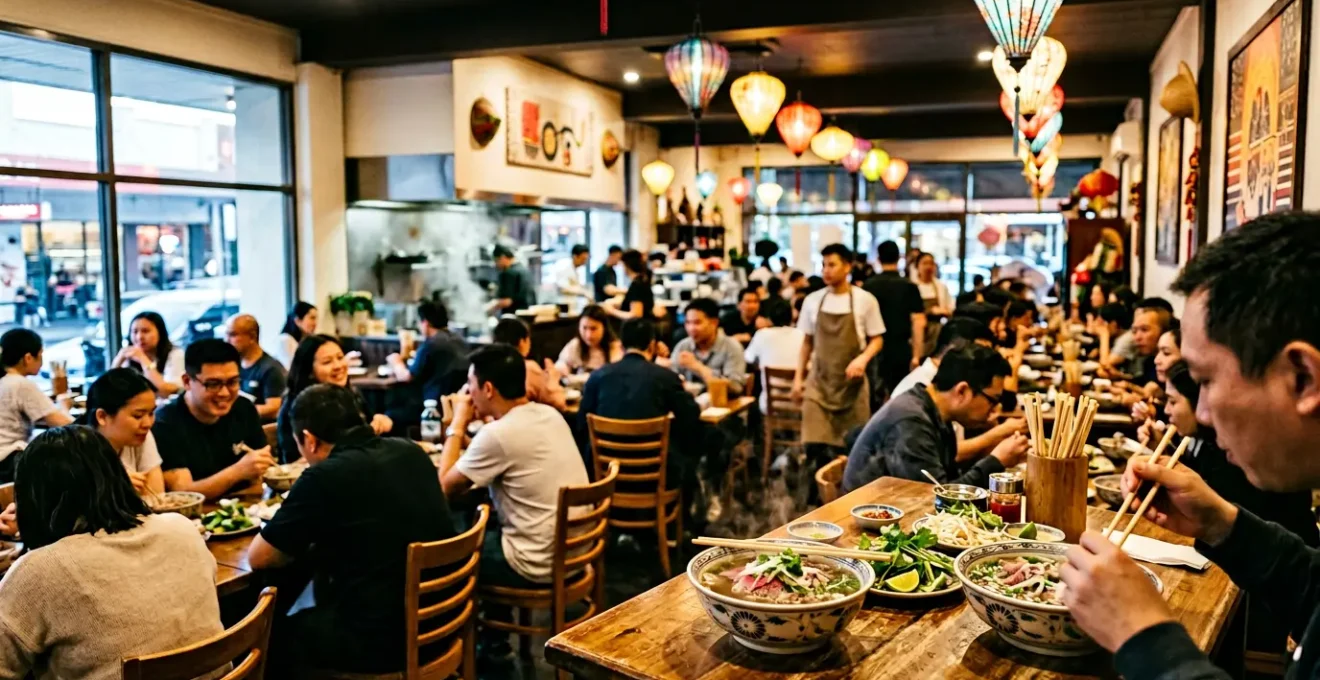
The best meals in a city are rarely found where the tourists are; they’re hidden in the suburbs where immigrant communities have built a culinary world of their own.
- Authenticity isn’t a static recipe but a living culture, which thrives in community hubs like Cabramatta, not the sanitised CBD.
- Suburbs develop a unique « postcode terroir, » where history, migration, and economics shape the flavour of their food, from Italian enclaves to coffee roaster hotspots.
Recommendation: Skip the inner-city « ethnic » restaurant and take a train to a suburb. Let its streets, supermarkets, and eateries tell you the real story of the city’s food.
The question isn’t just about a bowl of soup. To ask why Cabramatta serves the best pho in Sydney is to challenge the very geography of taste we’ve been sold. For decades, food lovers have been conditioned to hunt for authenticity in the polished, convenient confines of the central business district. We’re drawn to the city’s « Little Italy » or « Chinatown » as if they were culinary theme parks. But this is a comforting illusion, a CBD mirage. The true, beating heart of a city’s cuisine is rarely found in its centre.
The real story of food is a story of migration, of communities rebuilding their worlds one plate at a time in sprawling, often-overlooked suburbs. These areas are not just residential zones; they are living archives of culinary heritage. The flavours here are not diluted for tourist palates. They are a direct, unapologetic link to a homeland, shaped by the unique postcode terroir of their new Australian home. Cabramatta’s pho isn’t just better because of a recipe; it’s better because it is cooked in the social and cultural broth of a community that has defined itself through that very dish.
This journey is about understanding that culinary geography. It’s about trading the curated experience of the CBD for the vibrant, chaotic, and infinitely more rewarding reality of the suburbs. We will deconstruct the myth of the inner-city ethnic precinct, explore the historical layers of migration that created Modern Australian cuisine, and provide a new map for the adventurous eater—one where the train ticket is more important than the reservation.
This guide will explore how different suburban precincts across Australia have become crucibles of culinary identity, offering a framework for discovering these hidden gems for yourself.
Contents: The Suburban Food Critic’s Guide
- Leichhardt or Carlton: Where Is the True « Little Italy » of Australia?
- Lunar New Year in Sydney: Which Precinct Has the Best Dragon Dance?
- Asian Supermarkets: What Can You Find There That Coles Doesn’t Sell?
- The Ten Pound Poms: How Did British Migration Shape the 1950s?
- Modern Australian Cuisine: How Did « Mod Oz » Blend Asian and European Flavours?
- Fitzroy or Collingwood: Which Suburb Has the Highest Density of Roasters?
- Sop Sop and Semur: Where Can You Taste Authentic Island Cuisine?
- Kings Cross or Newtown: Which Sydney Precinct Is Safer for Solo Travellers?
Leichhardt or Carlton: Where Is the True « Little Italy » of Australia?
The concept of a « Little Italy » is one of Australia’s most enduring culinary myths. For decades, Leichhardt in Sydney and Lygon Street in Carlton, Melbourne, have been the default postcard images of Italian-Australian culture. But to visit them today expecting a vibrant, living community hub is to chase a ghost. These precincts are not epicentres of Italian life anymore; they are museums of it, sustained more by nostalgia and tourism than by a demographic reality. The truth is, authenticity follows the community, and the community has moved on.
The data paints a clear picture of this exodus. In Sydney, Leichhardt’s Italian-born population dropped from 5,000 in 1971 to 1,872 in 1991, and that trend has only continued as families sought larger homes and new opportunities in areas like Five Dock, Haberfield, and further west. Gentrification and rising property prices pushed the very people who gave the suburb its soul to its fringes. What remains is a high street of restaurants, but the cultural engine has largely departed.
This sentiment is echoed by those who have watched the change firsthand. Laura Mecca, the former Director of the Historic Italian Society, provides a sharp analysis of Melbourne’s equivalent. As she explained to SBS, the shift is undeniable:
There is still a bit of Italian culture in Lygon Street and Carlton, but these places are no longer the centre of Italian culture in Melbourne. If you look at the people that like visiting these suburbs regularly, you will see that often they don’t have an Italian background.
– Laura Mecca, Former Director of the Historic Italian Society
The real « Little Italy » today is not a single postcode. It’s a dispersed network of bakeries in Fairfield, delis in Haberfield, and family-run trattorias in suburban Melbourne. Finding it requires abandoning the guidebook and following the trail of the living heritage, not just the monuments of it.
Lunar New Year in Sydney: Which Precinct Has the Best Dragon Dance?
If the decline of the old « Little Italys » shows how culinary identity can fade, the fierce competition during Lunar New Year reveals how it can become a modern battleground for cultural supremacy. Asking which Sydney precinct has the « best » dragon dance is like asking which family member makes the best Christmas lunch: it’s a matter of intense local pride, commercial ambition, and a spectacle of one-upmanship. The city’s CBD Chinatown is the traditional heart, but suburbs like Cabramatta, Chatswood, and Hurstville now host massive festivals that rival, and in some ways surpass, the inner-city celebrations in terms of raw energy and community feel.
This suburban dynamism is a core part of Sydney’s identity. The city hosts one of the largest Lunar New Year celebrations outside Asia, and it’s a decentralised affair. According to the city’s own event promotions, the 2026 celebrations will sprawl across multiple key locations. Darling Harbour, for instance, has transformed the festival into a massive waterfront spectacle with elaborate dragon boat races featuring over 3,000 paddlers, jet pack water shows, and multiple lion dance troupes performing continuously. This isn’t just a community event; it’s a major tourist draw designed to pull crowds away from the more traditional precincts.
The lion dance itself becomes a visual metaphor for this competition. The skill, colour, and energy of a performance are a direct reflection of a community’s investment and pride.
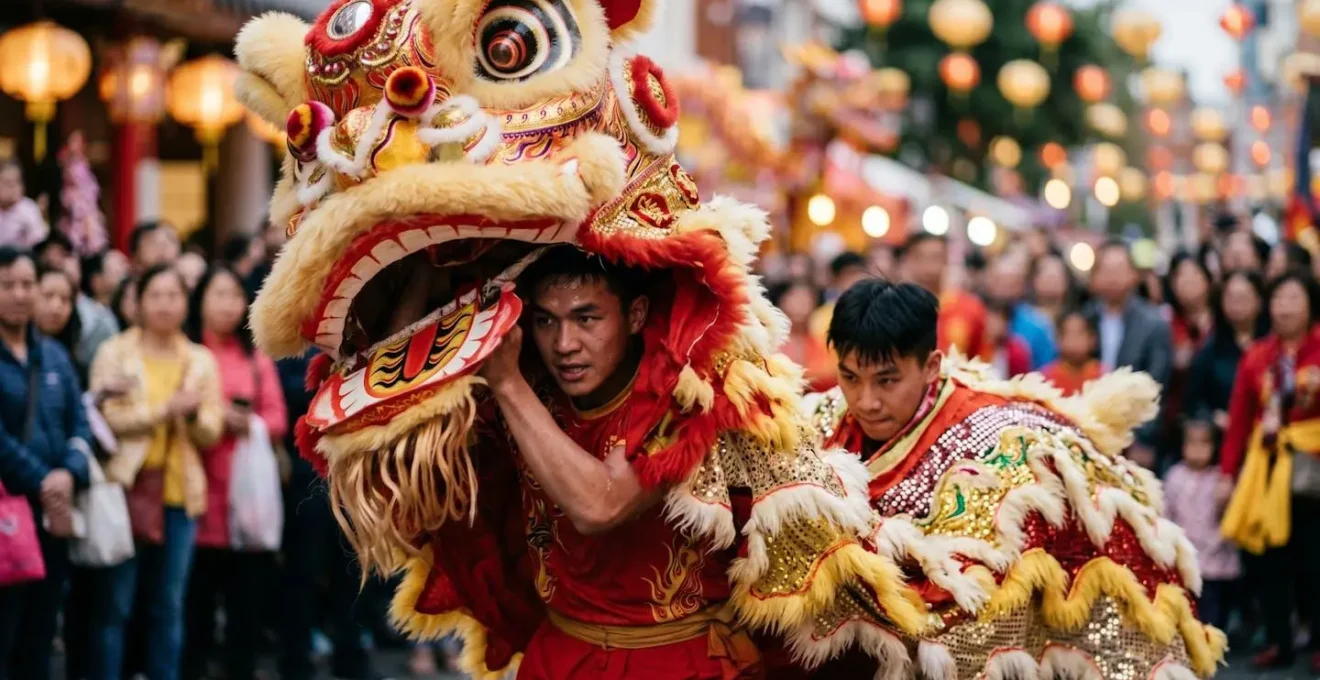
While the CBD offers grand, choreographed displays, the suburban events often feel more visceral and participatory. In Cabramatta, the streets are narrower, the firecrackers are louder, and the lions dance in and out of shops to bless the merchants. It’s less of a performance for an audience and more of an integral ritual within the community. The « best » dance, therefore, depends on what you seek: the polished spectacle of the city or the chaotic, immersive authenticity of the suburbs.
Asian Supermarkets: What Can You Find There That Coles Doesn’t Sell?
The soul of any suburban food scene isn’t just in its restaurants; it’s in its supermarkets. These are the pantries of a community, the places where the building blocks of authenticity are sold. For a food lover, walking into a large Asian supermarket in Cabramatta, Eastwood, or Chatswood is an act of discovery that a mainstream duopoly of Coles or Woolworths can never replicate. The sheer variety is a direct rebuttal to the sanitised, five-item « Asian » section in a typical Australian grocery store. This infrastructure is critical, especially when considering that Chinese Cuisine accounted for 26.4% of Australia’s ethnic food market in 2024, a demand that cannot be met by mainstream offerings.
The difference is not merely incremental; it is exponential. It’s the difference between a single brand of soy sauce and an entire aisle dedicated to light, dark, mushroom, sweet, and first-press varieties from different regions. It’s the difference between a sad, plastic-wrapped bunch of coriander and fragrant bundles of Thai basil, sawtooth coriander, and Vietnamese mint. These ingredients are not exotic novelties; they are non-negotiable essentials for creating dishes with true regional specificity.
This table illustrates the chasm between the curated, limited selection of mainstream supermarkets and the deep, culturally-specific offerings of their Asian counterparts. It highlights how the latter caters to a knowledgeable cook, not just a casual consumer.
| Product Category | Asian Supermarkets | Mainstream Supermarkets (Coles/Woolworths) |
|---|---|---|
| Sauce Variety | 50+ types of soy sauce, regional vinegars, specialty fermented sauces | 5-10 basic Asian sauces |
| Fresh Herbs | Thai basil, sawtooth coriander, pandan leaves, Vietnamese mint, lemongrass stalks | Italian basil, parsley, limited selection |
| Frozen Dumplings | Shanghai soup dumplings, Korean mandu, Japanese gyoza by region | Generic mixed Asian dumplings |
| Rice Selection | 15+ varieties: jasmine, sushi, glutinous, broken rice for specific dishes | 3-5 basic types |
| Cultural Items | Joss paper, incense, traditional kitchenware, medicinal herbs | None |
| Price Point | Often 20-40% cheaper for Asian products | Premium pricing for imported items |
To the uninitiated, these aisles can be intimidating. But with a little guidance, they become a treasure map to new flavours. The key is to look for specificity and ask questions.
Your Action Plan: Auditing an Asian Supermarket for Hidden Gems
- Sauce Aisle Deep Dive: Go to the soy sauce section. Identify a « first extract » or « black bean » soy sauce you’ve never tried. This is the foundation of many regional dishes.
- Herb Inventory: Locate the fresh herbs. Find one you don’t recognise, like perilla leaf or rice paddy herb. Ask a staff member or another shopper how they use it.
- The Freezer Test: Skip the generic spring rolls. Look for frozen goods with specific regional names, like Korean ‘mandu’ (dumplings) or Chinese ‘cong you bing’ (scallion pancakes).
- Noodle Nuance: Find the dried noodle aisle. Notice the difference between wheat, rice, and egg noodles of varying thicknesses. Pick one designed for a specific dish, like ‘dan dan’ noodles.
- The Non-Food Aisle: Explore the kitchenware section. Find a piece of equipment you’ve never seen, like a clay pot for rice or a specific type of cleaver. Understand its purpose.
The Ten Pound Poms: How Did British Migration Shape the 1950s?
To understand the ‘fusion’ in modern Australian food, one must first understand the distinct waves of migration that brought different culinary traditions to the country. Long before the flavours of Asia became mainstream, the « Ten Pound Poms » scheme dramatically reshaped Australia’s demographic and cultural landscape. This post-war initiative was a cornerstone of the « populate or perish » policy, driven by a desire to boost the nation’s workforce with British stock. The scale was immense: over 1 million British migrants arrived in Australia between 1945 and 1972 under the Assisted Passage Migration Scheme.
The promise sold to them was one of sun-drenched prosperity, a stark contrast to the grim, ration-book reality of post-war Britain. Historical archives capture this perfectly, detailing the powerful allure of the campaign:
They were offered a way out of the rationing and deprivation of post-war life, shown visions of glorious sunshine and boundless possibility by a government desperate for an influx of labour. They were offered the dramatically reduced fee for their passage only on the condition that they stay in Australia for a minimum of two years, or pay the full £120 fare back.
– Findmypast Historical Archive, Ten Pound Poms Historical Overview
However, the reality upon arrival was often a shock. Instead of the promised suburban dream, many were housed in spartan migrant hostels in places like Villawood or Bonegilla. These were basic, functional camps, a far cry from the idyllic life featured in the brochures. The experience was one of cultural dislocation and resilience, a foundational story of modern Australia.

While often associated with a « bland » food culture of roasts and boiled vegetables, this wave of migration laid down a European culinary foundation—techniques of baking, roasting, and butchery—that would later become the canvas upon which vibrant Asian and Mediterranean flavours were painted. They also brought a profound appreciation for a Sunday roast and a proper cup of tea, traditions that remain deeply embedded in the national psyche.
Modern Australian Cuisine: How Did « Mod Oz » Blend Asian and European Flavours?
« Mod Oz » is a term that can make a food critic cringe, often misused to describe any dish with a vague « Asian twist. » But at its best, Modern Australian cuisine is a legitimate and exciting culinary movement born directly from the country’s unique migration history. It is the logical, delicious outcome of the collision between the European cooking techniques brought by post-war migrants like the Ten Pound Poms and the influx of bold, aromatic ingredients from Asia and the Mediterranean that followed from the 1970s onwards.
The birth of Mod Oz happened not in domestic kitchens, but in the ambitious restaurants of the 1980s and 90s. Chefs like Tetsuya Wakuda, Neil Perry, and Kylie Kwong were pioneers. They had the classical European training but the curiosity and access to the incredible produce found in the suburban Asian supermarkets we’ve discussed. They started asking questions that would have been heretical a generation prior: What happens if you apply a French confit technique to a duck leg but serve it with a tamarind glaze? Or cure kingfish like an Italian crudo but dress it with soy, ginger, and finger lime?
This was not a clumsy « fusion » of slapping two cuisines together. It was a thoughtful integration based on a deep understanding of flavour, texture, and technique. Key characteristics of true Mod Oz cuisine emerged:
- Emphasis on Fresh, High-Quality Produce: A rejection of heavy, overwrought sauces in favour of letting the main ingredient shine.
- Bold, Clean Flavours: Using Asian ingredients like lemongrass, galangal, chili, and coriander to add aromatic lift to European-style dishes.
- New Techniques for Native Ingredients: Applying this global mindset to Australian native foods, like kangaroo, wattleseed, and lemon myrtle.
- A Lighter Touch: Moving away from the heavy butter-and-cream-based sauces of classic French cooking towards broths, vinaigrettes, and infused oils.
This was the moment Australian food culture came of age, creating a distinct identity that was confident, outward-looking, and a direct product of its multicultural postcode terroir. It was the taste of modern Australia on a plate.
Fitzroy or Collingwood: Which Suburb Has the Highest Density of Roasters?
Shifting our lens to Melbourne, we see the same principle of « postcode terroir » at play, but with a different protagonist: coffee. While Sydney’s suburban identity is often defined by waves of international migration, Melbourne’s inner-north has been shaped by a more recent internal migration of creatives, students, and professionals, creating a hyper-specific culinary niche. The rivalry between Fitzroy and Collingwood isn’t about ancient history; it’s a constantly evolving battle for the title of Melbourne’s coffee capital.
These two adjacent suburbs have become a global destination for coffee aficionados. You can’t walk 50 metres without stumbling upon a world-class cafe, a micro-roastery, or a workshop dedicated to the art of the perfect brew. This isn’t an accident. The area’s industrial past left a legacy of warehouses and factory buildings, providing the large, affordable spaces that roasters needed to set up their equipment. A young, discerning demographic provided the customer base, willing to pay a premium for single-origin, ethically sourced beans.
While Fitzroy, with its main artery of Brunswick Street, might have the historical edge as the original bohemian heartland, Collingwood has arguably become the epicentre of the craft. It’s grittier, more industrial, and home to some of the biggest names in the industry, like Proud Mary and Aunty Peg’s. These aren’t just cafes; they are « cellar doors » for coffee, offering cupping sessions, barista training, and direct-from-farm beans. They have created a concentrated ecosystem of expertise, where roasters, baristas, and customers are all engaged in pushing the culture forward.
So, which has the highest density? While it’s a tight race, Collingwood’s industrial backstreets likely give it the edge in terms of the sheer number of roasters operating per square kilometre. Fitzroy may have more cafes (the « retail » end), but Collingwood is the engine room. This friendly rivalry, however, is what makes the entire area so compelling. It’s a living laboratory for coffee, a perfect example of how a suburb can build a world-renowned reputation around a single product.
Sop Sop and Semur: Where Can You Taste Authentic Island Cuisine?
For the truly obsessed food explorer, the ultimate prize is to find a cuisine so hidden it barely registers on the national radar. While most Australians are familiar with the flavours of Southeast Asia and Europe, the culinary traditions of our own external territories remain a mystery. The food of the Cocos (Keeling) Islands and Christmas Island is a unique and delicious testament to a history entirely separate from mainland Australia’s, a vibrant blend of Malay, Indonesian, and Chinese influences.
Finding this food requires a deliberate journey. A small but proud community of Cocos Malay and Christmas Island Chinese-Australians have settled in specific pockets of Western Australia, particularly around Katanning. Here, and in a handful of homes and community events in Perth, you can find dishes that tell a story of trade routes, settlement, and island life. This is the definition of a hidden culinary gem, a world away from any CBD food court.
The flavours are intoxicating and unique. On the Cocos Keeling Islands, the cuisine is dominated by Malay traditions with a focus on coconut, fish, and chili. A signature dish is Sop Sop, a fragrant and hearty soup often made with chicken or beef, simmered with a complex blend of spices like galangal, lemongrass, and turmeric, and enriched with coconut milk. It’s a comforting, soulful dish that speaks of community gatherings.
Christmas Island’s food scene is different again, reflecting its history of phosphate mining and the diverse workforce brought there. Indonesian influence is particularly strong. Here you might find Semur, a sweet and savoury beef stew braised in ‘kecap manis’ (sweet soy sauce) with nutmeg and cloves, a dish with clear Dutch-Indonesian roots. These are not obscure recipes; they are the beloved, everyday foods of a community, a taste of home that has been carefully transplanted to the Australian mainland. To taste them is to participate in the preservation of a fragile and beautiful culinary heritage.
Key Takeaways
- True culinary authenticity is a living culture found in suburban community hubs, not a static exhibit in the CBD.
- A suburb’s « postcode terroir »—its unique history, migration patterns, and economics—directly shapes the taste and character of its food.
- Exploring a city’s food scene requires a curious mindset and a willingness to travel beyond the tourist map to its residential heart.
Kings Cross or Newtown: Which Sydney Precinct Is Safer for Solo Travellers?
For a traveller venturing into a city’s suburbs, the question of safety is always front of mind. But « safety » is a nuanced concept. It isn’t just about crime statistics; it’s also about a feeling of comfort, acceptance, and the ease of navigation. Comparing two of Sydney’s most famous inner-city precincts, Kings Cross and Newtown, reveals this difference perfectly. One has shed its dangerous reputation to become sanitised, while the other retains a bohemian edge that can feel either welcoming or intimidating depending on your perspective.
Kings Cross, historically Sydney’s notorious red-light district, has undergone a dramatic transformation. The controversial lockout laws of 2014, while devastating its nightlife, undeniably made the area statistically safer in terms of alcohol-fueled violence. Today, it’s a much tamer, more residential area with upscale restaurants and wine bars. For a solo traveller seeking a quiet, predictable environment, the modern Kings Cross is arguably « safer. » However, it has also lost much of its character, its grit replaced by a polished but somewhat sterile atmosphere.
Newtown, on the other hand, is the thriving, beating heart of Sydney’s alternative culture. It’s a vibrant, diverse, and proudly unconventional precinct. Its main thoroughfare, King Street, is a chaotic mix of students, artists, goths, and families. The atmosphere is overwhelmingly one of « live and let live. » For a solo traveller, particularly one who identifies as part of an alternative or LGBTQIA+ community, Newtown often feels psychologically safer than almost anywhere else in the city. It’s a place where individuality is celebrated, not judged. While it’s a busy, bustling area, its safety comes from its strong sense of community and a culture of mutual respect.

Ultimately, the choice depends on your definition of safety. If you prioritise predictability and quiet, the gentrified Kings Cross might be your pick. But if you seek the energy, diversity, and cultural safety of a community that embraces everyone, Newtown is the clear winner. It embodies the spirit of a truly great urban village: a place where you can be alone, but never feel lonely.
Now that you have a new map for culinary discovery, the next step is to put it into practice. Choose a suburb, take the train, and start your own adventure in search of the real taste of the city.