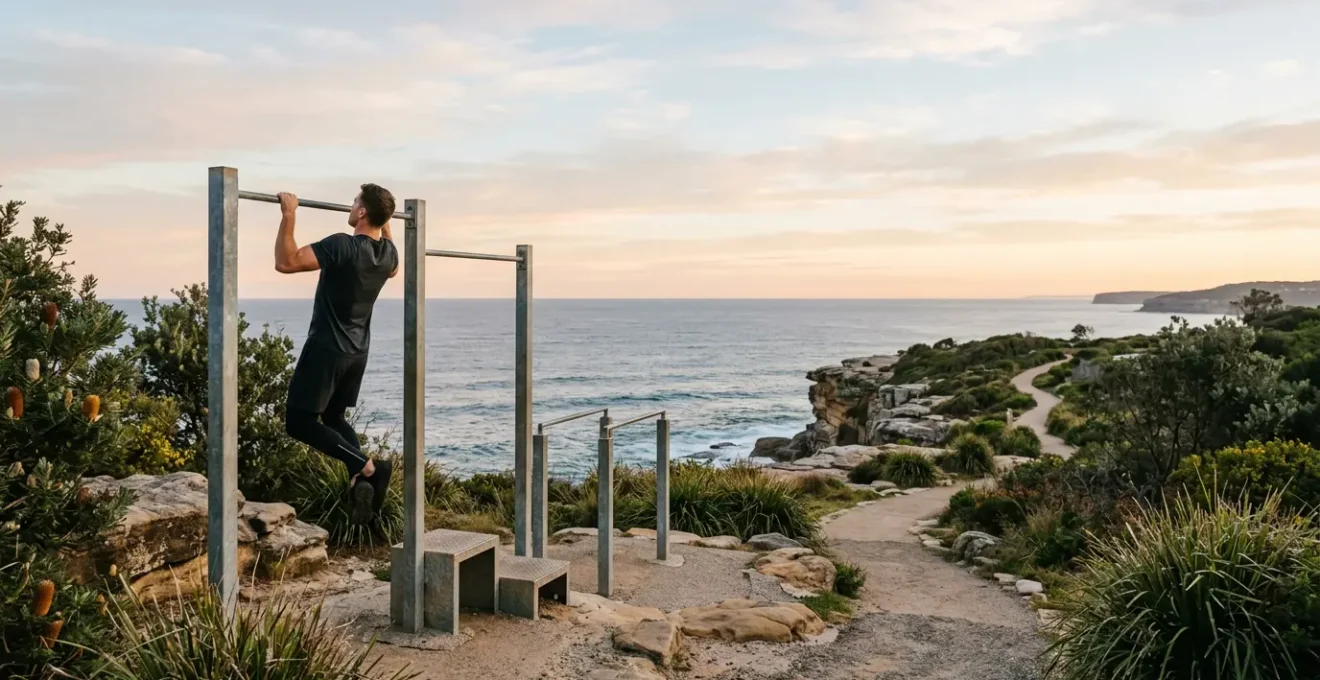
Maintaining peak fitness while travelling in Australia isn’t about finding a gym substitute; it’s about adopting a holistic « Travel Athlete » mindset.
- Sydney’s free outdoor gyms are your foundation for movement, but they are just the beginning.
- Proactive nutrition and recovery—addressing hydration, foot care, and sleep—are non-negotiable for performance on the road.
Recommendation: Integrate your fitness into the Australian environment itself—from ocean pools to local coffee rituals—for a more effective and authentic experience.
The thought can be demoralising for any active person: you’ve spent months building strength and endurance, only to see it potentially fade during a two-week holiday. The usual solutions feel inadequate. You could pay for an expensive gym day pass, but that eats into your travel budget. You could do push-ups in your hotel room, but that lacks inspiration and intensity. Many travellers simply resign themselves to losing their edge, promising to « get back on track » once they’re home.
But what if the goal isn’t to find a poor substitute for your home routine, but to upgrade your entire approach? This is the core of the « Travel Athlete » mindset. It’s about seeing your trip not as a break from your fitness, but as a new training environment. Your journey might be anchored in Sydney, but the true adventure often involves exploring the iconic East Coast. This guide starts with Sydney’s incredible free fitness infrastructure and then expands, giving you the complete playbook for staying in peak condition whether you’re in a Bondi park, a Byron yoga shala, or a Melbourne laneway.
We’ll go beyond just listing parks. We’ll build a holistic strategy that integrates movement, proactive nutrition, essential recovery, and even cultural immersion. You will learn not just where to train, but how to fuel your body from a single gas burner, how to manage the physical toll of constant exploration, and how to sync your body clock with a new continent. It’s time to stop worrying about losing gains and start seeing your holiday as the ultimate performance camp.
This guide is structured to give you a complete toolkit. We’ll cover everything from your workouts and meals to your recovery and mindset, providing practical, actionable advice for every leg of your Australian journey.
Summary: The Travel Athlete’s Guide to Staying Fit in Australia
- Healthy Eating in a Campervan: Meals You Can Cook on One Burner?
- Byron Bay Yoga: Where to Find Drop-In Classes with Ocean Views?
- Dehydration in Dry Heat: How Much Water Before You Feel Thirsty?
- Treating « Backpacker Feet »: How to Cure Blisters from Constant Walking?
- Melatonin or Morning Light: What Resets Your Body Clock Faster?
- Bronte vs Wylie’s Baths: Which Pool Is Better for Lap Swimming?
- Driver Reviver Stations: Free Coffee Spots You Should Actually Use
- Melbourne Coffee Etiquette: Why You Should Never Order a Starbucks?
Healthy Eating in a Campervan: Meals You Can Cook on One Burner?
For the travel athlete, food is fuel, not an afterthought. When you’re living out of a campervan, the single gas burner can feel like a major limitation, tempting you towards instant noodles and packaged snacks. But with a smart strategy, that one burner is all you need to create nutrient-dense meals that support your training and recovery. The key is a modular approach: think in terms of a base, a protein, vegetables, and flavour, all cooked in one pot or pan to minimise cleanup.
Your goal is to maximise nutritional value with minimal fuss. Canned goods are your allies here. Forget the stigma; canned tuna, salmon, chickpeas, and lentils are excellent sources of protein and are perfectly preserved for life on the road. Combine them with a quick-cooking base like couscous or wraps, and you have a solid foundation. Frozen vegetables are also a brilliant hack; they won’t spoil and can be thrown directly into your one-pot creations, ensuring you get your micronutrients.
Here’s a simple formula for building your meals:
- Step 1: Choose your base – rice, pasta, quinoa, couscous, or wraps as your foundation.
- Step 2: Add protein – canned fish (tuna, salmon), eggs, canned chickpeas, or pre-cooked chicken.
- Step 3: Include vegetables – spinach, tomatoes, onions, canned beans, frozen mixed vegetables.
- Step 4: Create flavour with sauce – curry powder with coconut milk, pesto, tomato paste, soy sauce with ginger.
- Step 5: Cook everything in one pan – start with aromatics (garlic, onion), add protein, then vegetables, and finally the sauce and base ingredients.
Case Study: The 10-Minute Fish Tacos for Australian Heat
When camping in Australia, the last thing you want is to spend time over a hot stove in a sweltering van. Fish tacos are a perfect solution. Using a single frying pan, fish goujons cook in oil in about 6-8 minutes. While they cook, you can chop tomatoes and red onion, mixing them with tinned beans and sweetcorn for a fresh salsa. The entire meal takes under 10 minutes, providing a high-protein, refreshing meal with minimal heat and effort—a critical consideration for any travel athlete exploring Australia in the summer.
By treating your campervan kitchen like a strategic refuelling station, you ensure your body has everything it needs to perform day after day.
Byron Bay Yoga: Where to Find Drop-In Classes with Ocean Views?
While Sydney provides the high-energy training grounds, a trip up the coast to Byron Bay offers a different but equally vital component of fitness: active recovery and mental focus. Yoga in Byron isn’t just exercise; it’s a ritual. For the travel athlete, a drop-in class is the perfect way to work on mobility, release muscle tension from long drives or hikes, and mentally reset. And nothing enhances that experience more than the sound of waves and a view of the Pacific Ocean.
The town is saturated with world-class yoga studios, but not all are created equal when it comes to ocean views. Some are tucked away in serene, forested retreats, while others are right on the sand. Choosing the right one depends on your goal. Are you seeking a rigorous, athletic practice or a relaxed, restorative session with a view? Many places are geared towards long-term members or retreat guests, but the best for a traveller offer casual, no-booking-required drop-in options.
For the ultimate experience, look for studios operating directly out of public spaces like surf clubs, as they often have the most unobstructed ocean vistas. It’s also worth noting that some resorts and hotels offer community classes. For instance, it’s not uncommon to find daily complimentary beachfront yoga classes hosted by local resorts, which can be a fantastic free option. The table below breaks down some of the top choices for a visitor looking to combine their practice with an epic view.
| Studio Name | Ocean View Quality | Drop-In Price | Atmosphere/Vibe | Location |
|---|---|---|---|---|
| Beachside Yoga & Massage | ★★★★★ Unobstructed – 2nd floor Byron Bay Surf Club, direct ocean views + wave sounds | $18 | For the Casual Drop-In: Relaxed, no bookings required, mats provided | Main Beach, Byron Bay Surf Club |
| Byron Yoga Centre | ★★★☆☆ Partial – 30 acres, 1km from beaches, forest setting with glimpses | $25 | For the Spiritual Seeker: Established 1988, Purna Yoga philosophy, retreat-style | 6 Byron St + Retreat Centre 1km from beaches |
| Creature Yoga | ★★☆☆☆ None – Minimalistic indoor studio, natural light, no ocean view | Intro: $49 (2 weeks unlimited) | For the Athletic Yogi: High standard instruction, 25 classes/week, modern clean space | Central Byron Bay location |
| Heat Yoga Byron | ★☆☆☆☆ None – Indoor studio in Arts & Industry Estate | $20 | For the Athletic Yogi: Hot yoga format, 90-minute classes, beginner-friendly | 8 Grevillea Street, Arts & Industry Estate |
This isn’t just about stretching; it’s about connecting your training to the incredible environment you’re in, making your recovery as memorable as your workouts.
Dehydration in Dry Heat: How Much Water Before You Feel Thirsty?
In the intense Australian heat, hydration isn’t just part of your routine; it is the most critical factor determining your performance and safety. The biggest mistake an athlete can make is waiting until they feel thirsty to drink. Thirst is a lagging indicator. In fact, expert sources confirm that if you feel thirsty, you are probably already dehydrated. For a travel athlete, this state of dehydration can lead to a rapid decline in performance, muscle cramps, heat exhaustion, or worse.
The key is a proactive hydration strategy. This means starting to drink water hours before you even begin your activity, whether it’s a run along the coast, a session at an outdoor gym, or a long hike. Your body needs time to absorb the fluid and reach a state of optimal hydration *before* you start sweating. During exercise, the goal is to consistently sip water to replace what you’re losing in real-time. For longer or more intense sessions in the heat (over 60 minutes), water alone may not be enough.

This is when electrolytes become crucial. When you sweat, you lose essential minerals like sodium, potassium, and magnesium. Replenishing these is vital for muscle function and fluid balance. While sports drinks are an option, you can also get electrolytes from natural sources like coconut water, a pinch of sea salt in your water, or fruits like bananas and oranges. Planning your hydration is just as important as planning your workout.
Your Action Plan: Proactive Hydration for Australian Heat
- Pre-hydration (2-3 hours before activity): Drink 500-600 mL of water to start well-hydrated.
- Pre-hydration top-up (30 minutes before): Drink an additional 240-300 mL to optimise fluid levels.
- During exercise (under 60 minutes): Sip water regularly throughout the activity.
- During exercise (over 60 minutes in heat): Switch to electrolyte drinks to replace sodium, potassium, and magnesium lost through sweat.
- Post-exercise rehydration: Drink 500-700 mL for every pound of body weight lost during exercise to fully recover.
Treating your water bottle with the same seriousness as your running shoes will be the single most important thing you do to stay strong and healthy under the Australian sun.
Treating « Backpacker Feet »: How to Cure Blisters from Constant Walking?
You can have the strongest legs and lungs in the world, but if your feet are covered in painful blisters, your journey as a travel athlete comes to a grinding halt. « Backpacker Feet »—the collection of hotspots, blisters, and general soreness from constant walking and hiking—are a common enemy. The good news is that they are almost entirely preventable with the right « pre-hab » protocol, and manageable if they do occur. The secret is to address friction and moisture before they become a problem.
Prevention starts long before you hit the trail. First, your choice of socks is critical. Cotton is your worst enemy; it absorbs sweat and holds it against your skin, creating the perfect environment for friction and blisters. Opt for merino wool or synthetic socks that wick moisture away. Second, ensure your shoes are properly broken in. Wear them on short walks before your trip to identify potential hotspots. For those known problem areas, apply preventative taping with a durable sports tape *before* you start your day’s adventure. It’s far easier to prevent a blister than to treat one.
If a blister does form, your treatment approach matters. Don’t just slap on a regular plaster. Specialised blister treatments create a cushioned, low-friction environment that promotes healing while allowing you to keep moving. Hydrocolloid dressings like Compeed are a game-changer; they act like a second skin, providing excellent cushioning and can stay on for several days. Understanding the different product types helps you build a robust foot-care kit.
Here is a pre-hab protocol to make your feet resilient:
- Step 1: Select merino wool or synthetic socks (never cotton) – they wick moisture and reduce friction in Australian heat.
- Step 2: Break in shoes with short walks – wear them around the house, to shops, then progress to short day walks before long trips.
- Step 3: Apply preventative taping to known hotspots – use Leukoplast or similar sports tape on heels, arches, or toes before blisters form.
- Step 4: Consider a liner sock system – wear a thin liner sock under your hiking sock to create a friction layer away from your skin.
- Step 5: Allow feet to toughen – gradual exposure through practice hikes builds natural skin resilience.
| Product Type | Best Use Case | Application | Pros | Cons |
|---|---|---|---|---|
| Compeed (Hydrocolloid) | Hotspots & existing blisters (heel, ball of foot) | Apply to clean, dry skin; leave on for several days | Superior cushioning, prevents hotspot progression, stays on for days, promotes moist healing | More expensive, requires replacement if edges lift |
| Moleskin | Prevention on high-friction zones (side of foot, toes) | Cut to size, apply to skin or shoe before hiking | Durable, sticks well, classic reliable option, affordable | Can be bulky, less cushioning than hydrogel, may need frequent replacement |
| Hydrogel Pads (2nd Skin) | Cooling relief for painful blisters (between toes, pinky toe) | Apply gel pad directly to blister, cover with adhesive | Cooling sensation, soothes pain, promotes healing | Less durable, may slip in sweaty conditions, needs securing bandage |
| Engo Patches | Preventative in-shoe application (heel cup, arch, forefoot) | Stick inside shoe at friction point (not on skin) | Lasts weeks/months, eliminates friction source, very effective prevention | Only preventative (not treatment), requires knowing problem areas in advance |
By investing in proper socks and a small, well-stocked blister kit, you ensure your feet can carry you through every adventure Australia throws at you.
Melatonin or Morning Light: What Resets Your Body Clock Faster?
Crossing multiple time zones to reach Australia delivers a significant shock to your system. Jet lag isn’t just about feeling tired; it’s a complete disruption of your circadian rhythm, the internal 24-hour clock that governs everything from your sleep-wake cycle to your hormone production and metabolism. For a travel athlete, this can crush your motivation and physical capacity. The two most talked-about tools for resetting this clock are melatonin supplements and natural morning light. So, which is more effective?
Melatonin is the hormone your brain produces in darkness to signal that it’s time to sleep. Taking a supplement can help you fall asleep when your body clock is still screaming « daytime. » It can be a useful tool to force sleep on the first couple of nights. However, it’s a blunt instrument. It helps initiate sleep, but it doesn’t do as much to actively *shift* your entire circadian rhythm forward. It’s a patch, not a reset button.
Natural morning light, on the other hand, is the most powerful signal for resetting your body clock. When bright light hits your retinas in the morning, it sends a strong message to your brain’s master clock (the suprachiasmatic nucleus) to suppress melatonin production, raise cortisol, and essentially start your internal day. This is the mechanism that synchronises your body to the new local time. While melatonin can help you sleep, morning light actively wakes you up and anchors your rhythm.
The best strategy for the travel athlete is to use light as the primary tool. On your first morning in Sydney, no matter how tired you are, force yourself to get outside for at least 30 minutes of bright, natural light. Go for a walk, have your coffee outside, or do a light workout at a beachside park. This exposure is far more effective at telling your body « this is the new morning » than any pill. You can use a low dose of melatonin to help you get to sleep at a reasonable local time for the first one or two nights, but your main focus should be on chasing that morning sun.
By prioritising light exposure, you’re not just fighting jet lag; you’re actively taking control of your body’s core operating system, setting yourself up for a high-performance trip from day one.
Bronte vs Wylie’s Baths: Which Pool Is Better for Lap Swimming?
For the swimming enthusiast, Sydney’s ocean pools are a dream come true. Carved out of the rocky coastline, these saltwater sanctuaries offer a unique training environment that a chlorinated indoor pool could never replicate. Two of the most famous pools in the Eastern Suburbs are Bronte Baths and Wylie’s Baths. While both are spectacular, they offer different experiences for someone looking to do serious lap swimming.
Bronte Baths is the clear choice for the dedicated lap swimmer. Its key advantage is its length and structure. At approximately 30 metres long with lane markings painted on the pool floor, it’s purpose-built for continuous, rhythmic swimming. The flat, accessible concrete deck all around the pool makes for easy entry and exit, and a predictable environment. While it can get crowded, especially on sunny weekends, visiting on a weekday morning often provides a clear run for a solid workout. The iconic setting, with waves from Bronte Beach crashing against the pool wall, is just a bonus.
Wylie’s Baths, just south in Coogee, is a different beast altogether. It’s a much more natural, almost magical experience. Perched on a large timber deck below the cliffs, the pool itself is more irregularly shaped and its bottom follows the natural rock shelf. While it is about 50 metres long, the lack of formal lanes and the uneven floor make it less ideal for uninterrupted, paced laps. Wylie’s is better for a restorative dip, a gentle swim, or simply soaking in the historic, charming atmosphere. It’s an incredible place to experience, but for a structured swim session, it can be frustrating.
So, the verdict for the travel athlete is clear. If your goal is a focused, high-quality swimming workout where you can track your distance and maintain a steady pace, head to Bronte. If your goal is a beautiful, relaxing, and uniquely Australian swimming experience as a form of active recovery, then Wylie’s Baths is an unforgettable choice. For pure training, however, Bronte’s structure gives it the edge.
Both are worth visiting, but for the specific purpose of lap swimming, Bronte is the more efficient and reliable training partner.
Driver Reviver Stations: Free Coffee Spots You Should Actually Use
Driving long distances is an integral part of the Australian travel experience, especially if you’re exploring the coast in a campervan. But fatigue is a silent threat that can derail your trip and your safety. This is where Driver Reviver stations become an essential tool in the travel athlete’s arsenal. These are not just roadside cafes; they are volunteer-run rest stops set up during peak holiday periods along major highways, offering free coffee, tea, and biscuits to encourage drivers to take a break.
For the budget-conscious traveller, the offer of free coffee is obviously appealing. But for the travel athlete, the value of these stations goes much deeper. It’s about strategic fatigue management. Driving for hours on end is mentally and physically draining. A Driver Reviver station provides a structured, designated point to stop, get out of the car, stretch your legs, and have a moment of human interaction. The caffeine is a short-term boost, but the act of taking a 15-20 minute break is what truly combats fatigue.
Think of it as a mandatory recovery session during your long-haul transit days. Instead of pushing on to the next town, feeling increasingly drowsy, you can plan your journey around these stops. They are typically well-signposted in advance, allowing you to incorporate them into your travel itinerary. Using them is a smart, proactive safety measure that aligns perfectly with the holistic approach of a travel athlete. You wouldn’t skip a cool-down after a workout; you shouldn’t skip a rest break on a long drive.
These stations are a uniquely Australian institution, powered by community spirit and a genuine concern for road safety. By stopping, you’re not only doing yourself a favour, but you’re also supporting a valuable volunteer initiative. So next time you see the « Driver Reviver 1km ahead » sign, don’t just drive past. Pull in, grab a free cuppa, and give your body and mind the break they need to arrive at your next destination safely and ready for the next adventure.
It’s a simple, free, and incredibly effective way to manage the physical demands of an Australian road trip.
Key takeaways
- Fitness while travelling is a holistic system connecting movement (outdoor gyms), fuel (smart campervan cooking), and recovery (hydration, sleep, foot care).
- Proactive strategies are always better than reactive ones. Hydrate before you’re thirsty, tape your feet before they blister, and seek morning light to beat jet lag from day one.
- Embrace the environment as your gym. Sydney’s ocean pools, Byron’s beachside yoga, and even highway rest stops are all tools for the savvy travel athlete.
Melbourne Coffee Etiquette: Why You Should Never Order a Starbucks?
After pushing your body in Sydney’s parks and on coastal hikes, your journey might lead you to the cultural heart of Australia: Melbourne. Here, the training shifts from the physical to the sensory. And nothing is more central to the Melbourne experience than its coffee culture. Understanding the local coffee etiquette isn’t just a quirky travel tip; for the travel athlete, it’s about engaging with your environment and appreciating the high standards that define the city. And rule number one is this: you don’t order Starbucks.
This isn’t just snobbery; it’s a reflection of a city that has one of the most developed and passionate independent coffee scenes on the planet. Melbourne’s laneways are packed with world-class cafes, each with its own expert baristas, specialty bean suppliers, and devoted regulars. Coffee here is treated as a craft, an art form. To walk past hundreds of these unique, high-quality establishments to order a generic, mass-produced coffee from a global chain is seen as an almost insulting lack of awareness.
For the travel athlete, who thrives on optimisation and quality, this presents an opportunity. Instead of a predictable latte, you can explore the nuances of a ‘Magic’ (a specific local concoction of a double ristretto topped with steamed milk), a single-origin pour-over, or a perfectly pulled long black. Engaging with a local barista, asking about their house blend, and taking a moment to savour a genuinely exceptional coffee is a form of sensory training and mindfulness. It’s a small ritual that connects you deeply to the place you’re in.
This final piece of the puzzle reinforces the core philosophy of the travel athlete: it’s all connected. The discipline you apply to your workouts, the care you put into your nutrition, and the attention you pay to your recovery should also extend to how you experience the world around you. Choosing a local cafe over a global chain is a vote for quality, craft, and community—the very same values that drive you to be a better athlete. It’s the perfect cool-down to a high-performance Australian adventure.
Now, stop planning and start training. Take this mindset with you and turn your next Australian adventure into your best performance yet.