The Australian Outback is not a theme park; underestimating its vastness and harshness is the most common and potentially fatal mistake a traveller can make.
- Your water supply dictates your survival timeline: the 5-litre per person per day rule is a hard limit based on human physiology in extreme heat, not a soft guideline.
- Vehicle choice and preparation are paramount; a standard 2WD campervan is a significant liability on unsealed roads, and GPS is a proven point of failure that demands a physical map backup.
- Driving at dawn or dusk multiplies collision risks with dense, vehicle-wrecking wildlife like wombats, turning a scenic drive into a potential survival scenario.
Recommendation: Treat every safety rule detailed in this guide not as optional advice, but as a non-negotiable protocol dictated by the physics and logistics of remote survival. Your preparation is your primary lifeline.
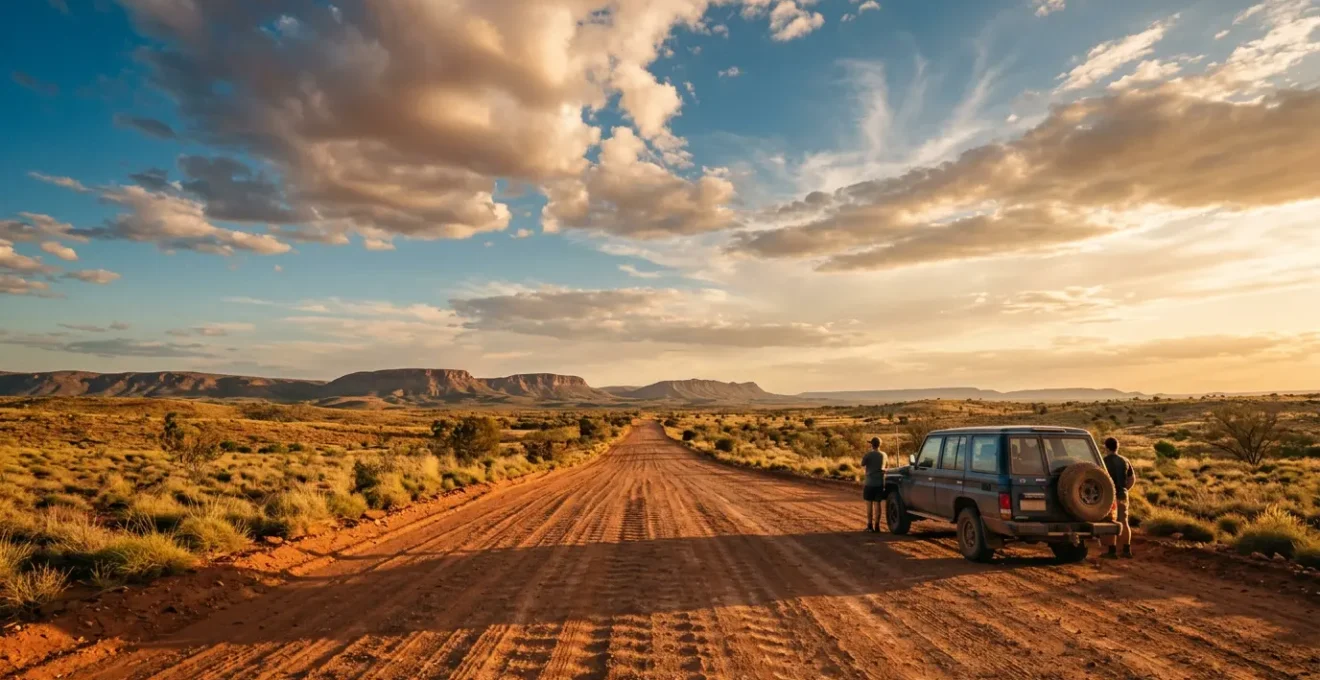
The vision is iconic: a campervan cruising down a deserted red-dirt road, a trail of dust against an endless blue sky. This romantic image of an Australian Outback adventure draws thousands of travellers each year. But this landscape, while beautiful, is one of the most unforgiving on Earth. The distance between you and the nearest help isn’t just inconvenient; it’s a critical factor in a survival equation that many tragically miscalculate.
Common advice circulates in online forums and travel blogs: « pack extra water, » « watch out for kangaroos, » and « make sure you have a spare tyre. » While not incorrect, this level of guidance is dangerously superficial. It treats the immutable laws of physics and biology as friendly tips. The truth is, surviving the Outback isn’t about having a checklist of items; it’s about understanding the non-negotiable protocols that govern this environment. A small mistake, a moment of complacency, can trigger a cascade of failures with life-threatening consequences.
This guide moves beyond the platitudes. We will not just tell you *what* to do; we will deconstruct the *why* behind each critical safety rule. We will explore the physics of tyre pressure on corrugated roads, the grim timeline of dehydration in 40°C heat, and the logistical certainty required for fuel management. This is not a list of tips. This is a manual of essential, non-negotiable survival protocols for anyone serious about crossing the Red Centre and returning safely.
To navigate the complexities of Outback travel, this guide is structured to address the most critical safety protocols in a logical sequence. The following summary outlines the key areas we will cover, transforming vague warnings into actionable, life-saving knowledge.
Summary: Your Essential Outback Survival Protocols
- 2WD vs. 4WD: Can You Really Drive the Mereenie Loop in a Campervan?
- What to Do If You Break Down 200km from the Nearest Town?
- Why You Should Never Drive at Dawn or Dusk in Rural Australia?
- Satellite Phone or UHF Radio: Which Safety Gear Is Essential for Remote Trips?
- Mapping Fuel Stops: The Risk of Passing a Roadhouse Without Filling Up
- GPS Failure: Why Must You Carry Paper Maps in the Red Centre?
- Tyre Pressure for Corrugations: What PSI Prevents Blowouts on the Loop?
- Surviving the Arid Zone: Why 5 Litres of Water Per Day Is the Minimum?
2WD vs. 4WD: Can You Really Drive the Mereenie Loop in a Campervan?
The question of whether a 2WD campervan can handle unsealed Outback roads like the Mereenie Loop is a common one, and the answer is a dangerous « sometimes. » Technically, in perfect, dry conditions, a 2WD vehicle might make it through. However, this perspective ignores the fundamental principle of Outback safety: you must prepare for the worst conditions, not hope for the best. A 2WD campervan is a significant liability. Its lower ground clearance makes it susceptible to damage from rocks and deep ruts, while its lack of traction can leave you stranded after even a brief, unexpected rain shower turns the track to mud.
The chassis and suspension of a standard campervan are not designed for the relentless, high-frequency vibrations of corrugated roads. This stress can lead to mechanical failure, from shattered suspension components to ruptured fluid lines. While a 4WD vehicle provides superior traction, ground clearance, and structural integrity, its greatest advantage is the margin of safety it provides when conditions inevitably deteriorate. Choosing a 2WD for such a trip is a gamble against the environment, where the stakes are your safety and survival.
Case Study: The 2WD Sedan on the Mereenie Loop – A Cautionary Tale
A traveller documented their attempt to drive the Mereenie Loop in a standard 2WD Holden Commodore sedan. While they successfully completed the route in dry weather, the journey was a harrowing experience. The dirt section, which typically takes 2-3 hours in a 4WD, took them over four hours, with speeds dropping as low as 20km/h on severely corrugated sections. The driver described the ordeal as « a nightmare » and « not worth it, » highlighting extreme vehicle stress and passenger discomfort. This real-world example demonstrates that « possible » does not mean « advisable » or « safe, » and strongly cautions against underestimating the road’s demands.
Ultimately, treating a 4WD as an optional upgrade rather than a baseline requirement for remote unsealed tracks is a critical error in judgment. It prioritises budget over the physics of the terrain, a mistake the Outback does not forgive.
What to Do If You Break Down 200km from the Nearest Town?
A vehicle breakdown in the remote Outback is the moment every safety protocol is tested. The single most important rule is to STAY WITH YOUR VEHICLE. Your car is a large, visible target for rescuers and provides life-saving shelter from the extreme elements. Wandering off in search of help is a statistically proven fatal error; in this environment, an average of 40 deaths per year are attributed to such scenarios. Survival depends on a calm, methodical response in the first 60 minutes.
Your immediate actions should follow a strict protocol. First, assess and mitigate any immediate danger, moving the vehicle off the track if possible. Second, activate your primary emergency communication device, be it a satellite phone or a Personal Locator Beacon (PLB). Provide clear, concise information: your GPS coordinates, vehicle description, number of people, and the nature of the emergency. Only then do you shift focus to passive signals, inventory of supplies, and establishing your vehicle as a long-term shelter. Every action must be deliberate and aimed at conserving energy and water while maximizing your chances of being found.
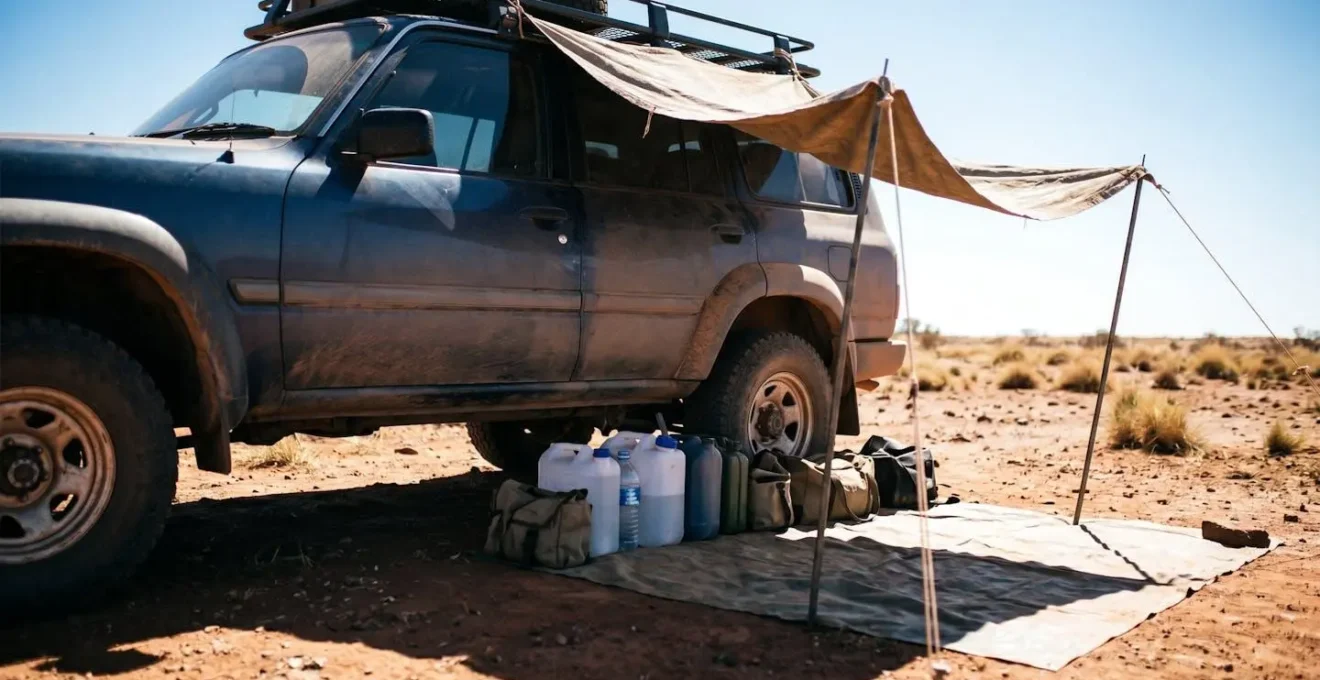
As the illustration shows, your vehicle transforms into your primary survival tool. It offers shade from the relentless sun, a windbreak, and a secure place to store your critical supplies. Using a tarp to extend the shade and keeping water containers out of direct sunlight are simple but crucial steps to manage your micro-environment. Panic is your greatest enemy; a clear, rehearsed protocol is your greatest asset.
Your Pre-Departure Critical Systems Audit
- Communication Lifelines: List all communication devices (Sat Phone, PLB, UHF). Test batteries, check subscriptions, and log emergency numbers.
- Fluid & Fuel Inventory: Physically check levels of engine oil, coolant, and brake fluid. Verify total fuel capacity (tanks + jerry cans) against your calculated safe range.
- Tyre System Integrity: Inspect all tyres (including at least one, preferably two, spares) for wear and damage. Confirm you have a working jack, tyre gauge, and repair kit.
- Water Security & Redundancy: Tally total water volume. Check that it is stored in multiple, separate, food-grade containers. Differentiate drinking water from utility water.
- Navigation & Power Plan: Ensure paper maps cover the entire route. Check that all digital devices (GPS, phones) have offline maps downloaded and verify your vehicle’s charging system and power banks are functional.
Why You Should Never Drive at Dawn or Dusk in Rural Australia?
Driving during the twilight hours of dawn and dusk in the Outback is not a scenic opportunity; it is a calculated risk with a high probability of catastrophic failure. This is the time when most native wildlife is active, a period known as being ‘crepuscular’. The low light plays tricks on depth perception, and the dusty, monotonous landscape provides perfect camouflage for animals. A collision is not a minor incident—it’s often a trip-ending, vehicle-destroying event.
The danger is not an exaggeration. An analysis of insurance claims by AAMI revealed 23,840 wildlife collision claims, with dusk being the single riskiest period. Kangaroos are the most well-known hazard, but they are not the most dangerous. Their tendency to panic and jump erratically makes them unpredictable, but the real vehicle-wreckers are smaller, denser animals.
Case Study: The Wombat Factor – Why They’re Called ‘Four-Wheel-Drive Wreckers’
Wombats are a prime example of the unique physics of Outback collisions. Due to their incredibly dense, muscular build and low centre of gravity, they do not absorb impact. Instead, they act like a solid block of concrete. Hitting a wombat, even at a moderate speed of 60-80km/h, rarely sends it flying. Instead, the vehicle’s front end is forced up and over it, resulting in catastrophic damage to the undercarriage, including shattered radiators, destroyed steering components, and broken suspension. Insurance data confirms that wombat strikes frequently lead to vehicle write-offs, with repair costs far exceeding those from kangaroo collisions.
The protocol is simple and non-negotiable: be off the road and at your campsite at least one hour before sunset, and do not start driving until one hour after sunrise. This single discipline mitigates one of the most common causes of Outback travel emergencies. Planning your daily travel distances around this rule is a fundamental part of a safe itinerary.
Satellite Phone or UHF Radio: Which Safety Gear Is Essential for Remote Trips?
In the vast silence of the Outback, where mobile phone reception is a distant memory, your choice of communication device is your lifeline. The debate between a Satellite Phone and a UHF (Ultra High Frequency) Radio is not about which is « better, » but about understanding their fundamentally different roles. A UHF radio is a tool for coordination, excellent for vehicle-to-vehicle communication within a convoy. A Satellite Phone is a tool for emergency response, providing a direct link to help anywhere on the planet, regardless of who else is around.
As Outback travel expert Allan Whiting from Outback Travel Australia states, the choice is clear for anyone serious about safety:
We recommend the satellite telephone as the top communication option in the Outback, we never leave home without ours.
– Allan Whiting, Outback Travel Australia – Communications Options Guide
The critical difference is range and reliability. A UHF radio’s effectiveness is limited by line-of-sight, often reduced to less than 15km in hilly or forested terrain. If you break down alone, a UHF radio is likely to be useless. A satellite phone, however, connects you directly to the global satellite network, allowing you to speak with emergency services or family and relay the precise nature of your situation. A third option, the Personal Locator Beacon (PLB), is a crucial last-resort device. It sends a one-way distress signal but offers no two-way communication. The ideal setup is not one or the other, but a combination: a UHF for convoy logistics, a PLB for a worst-case scenario, and a satellite phone as the primary tool for managing any serious incident.
This comparative table breaks down the capabilities of each device, making it clear that for solo or remote travel, the satellite phone is not a luxury, but an essential piece of survival equipment.
| Criteria | Satellite Phone | UHF Radio | PLB (Personal Locator Beacon) |
|---|---|---|---|
| Best Use Case | Solo travel, extreme remote areas, medical emergencies requiring two-way communication | Convoy travel, vehicle-to-vehicle communication, short-range coordination | Life-threatening emergency when other comms fail |
| Range | Global (Iridium), Australia-wide coverage | Typically under 50km line-of-sight, often 15km practical limit | Global satellite detection |
| Communication Type | Two-way voice, SMS, limited data | Open-channel voice (anyone can hear), real-time | One-way emergency SOS signal only |
| Initial Cost | $500-$1500 (purchase) or $50-150/week (rental) | $200-$600 for vehicle unit + antenna installation | $300-$500 (one-time purchase) |
| Ongoing Costs | $15-$100/month depending on plan + per-minute call charges | None (license-free in Australia) | None (registration free) |
| Response Time | Immediate two-way contact with emergency services or contacts | Depends on other vehicles in range (could be none) | Rescue dispatch typically 1-4 hours, actual rescue time varies |
| Limitations | Expensive calls, requires clear sky view, battery dependent | Very limited range, useless if no other vehicles nearby, no emergency services contact | Cannot communicate details, situation updates, or cancel false alerts easily |
Mapping Fuel Stops: The Risk of Passing a Roadhouse Without Filling Up
In urban driving, a fuel gauge nearing empty is an inconvenience. In the Outback, it’s the start of a potential survival crisis. The « she’ll be right » attitude has left countless travellers stranded. The distances are immense, and the assumption that another fuel stop is « just up the road » is a fallacy. In many parts of the Outback, fuel stations can be 200-300km or more apart. Furthermore, roadhouses can be closed without warning due to staff shortages, delivery issues, or equipment failure. The only safe protocol is to refuel at every single opportunity, regardless of how much is left in your tank.
This rule must be combined with a precise understanding of your vehicle’s consumption and range. The manufacturer’s stated fuel economy is irrelevant; it was not calculated for a fully loaded campervan driving on corrugated dirt roads. You must calculate your *actual* consumption in Outback conditions. This leads to the most critical calculation of your trip: your Point of No Return. This is the exact geographical point on your map between two fuel stops where you no longer have enough fuel to turn back to the previous one. Knowing this point for every leg of your journey is a non-negotiable part of logistical planning.
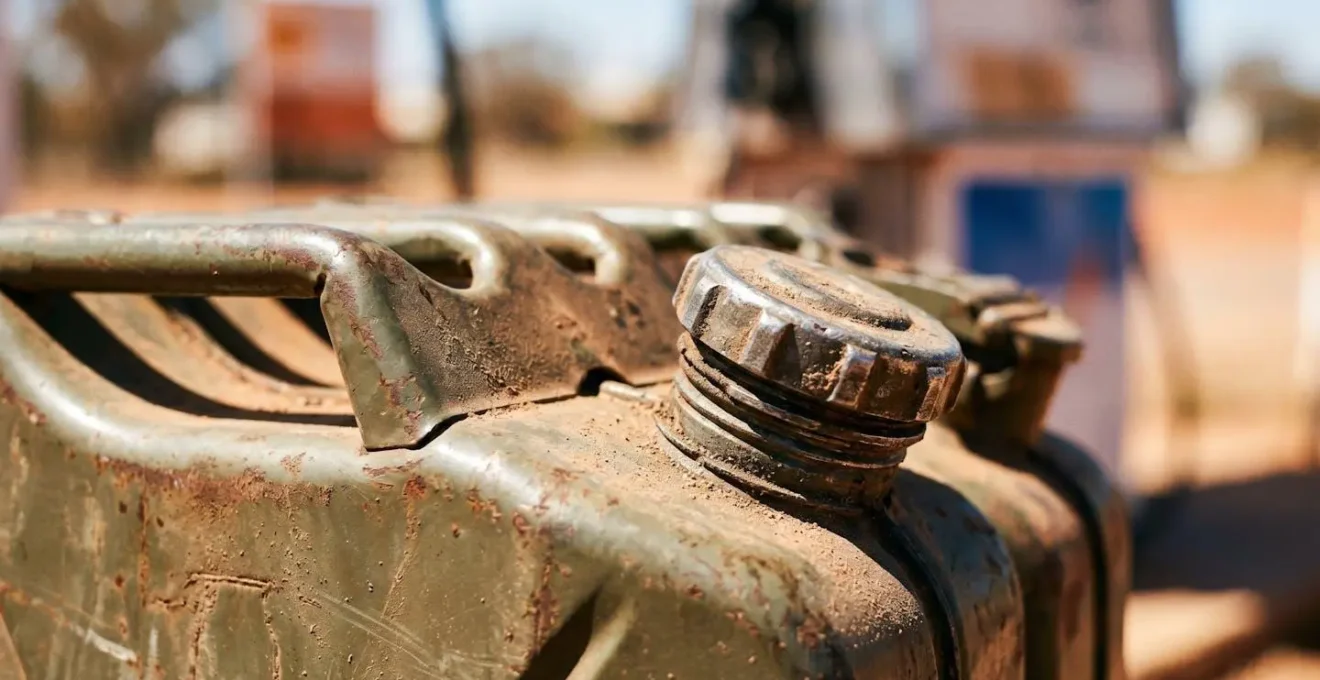
Carrying jerry cans is not just for extending your range; it’s your strategic reserve. It’s the buffer that accounts for unexpected detours, increased fuel consumption due to headwinds or soft sand, or the sudden closure of a planned fuel stop. The following method provides a framework for calculating your safe fuel range.
- Step 1: Know your vehicle’s actual fuel consumption in litres per 100km, based on real-world loaded driving, not manufacturer claims.
- Step 2: Measure your total fuel capacity, including all tanks and jerry cans.
- Step 3: Calculate your maximum theoretical range based on your actual consumption.
- Step 4: Apply the ‘50% safety buffer’ rule. Never plan a leg that uses more than half of your maximum range between confirmed, open fuel stops.
- Step 5: Identify and mark your ‘Point of No Return’ on both your physical map and GPS for every single leg of the journey before you depart.
GPS Failure: Why Must You Carry Paper Maps in the Red Centre?
In an age of digital convenience, relying solely on a GPS for navigation in the Outback is a critical and common mistake. Digital systems fail for many reasons: device overheating in a hot cabin, battery failure, software glitches, or a simple cracked screen from a bumpy ride. More insidiously, GPS data can be dangerously inaccurate in remote areas, leading travellers down « phantom roads » that are impassable or non-existent. The only reliable backup is the one that doesn’t need batteries: a set of high-quality, up-to-date paper maps.
Paper maps, such as those from Hema Maps, are not just a backup; they are a primary tool for situational awareness. They provide a « big picture » view that a small GPS screen cannot, allowing you to see your route in the context of the surrounding terrain, alternative tracks, and emergency exit points. They contain crucial information often missing from digital maps, such as track conditions (e.g., « sandy, » « rocky, » « 4WD only »), locked gates, and land tenure (Aboriginal land, pastoral lease) that may require permits.
Case Study: The Digital Over-Reliance Trap
Countless incidents are documented each year where tourists, blindly following their GPS, have been routed down impassable tracks. These « phantom roads » may be old mining access routes, private station tracks, or paths that have been washed away for decades. Digital maps often show these as viable shortcuts because the data is outdated or lacks context. In one common scenario, a GPS might direct a 2WD campervan down a track that is strictly for high-clearance 4WDs. A paper map, with its clear symbology and annotations, would have immediately identified the track as unsuitable, preventing a potentially dangerous situation.
Carrying a paper map without knowing how to use it is also insufficient. A basic understanding of map reading, including how to use the legend, understand contour lines, and triangulate your position with a compass, is an essential survival skill. The map and compass are a system that works when all else fails.
Tyre Pressure for Corrugations: What PSI Prevents Blowouts on the Loop?
The corrugated roads of the Outback are a vehicle’s worst enemy. These relentless, washboard-like ripples generate intense, high-frequency vibrations that can literally shake a vehicle apart. The key to mitigating this destructive force lies not in speed, but in tyre pressure. Driving on corrugations with highway-pressure tyres is a recipe for disaster. The hard, over-inflated tyre cannot absorb the impacts; instead, it bounces violently from the top of one ripple to the next, transferring the full force of the shock into your suspension, chassis, and everything inside the car.
The correct protocol is to lower your tyre pressure significantly. By reducing the PSI (pounds per square inch), you soften the tyre, allowing it to deform and absorb the ripples instead of fighting them. This lengthens the tyre’s footprint on the ground, effectively allowing it to ‘float’ over the corrugations. This dramatically improves ride comfort, but more importantly, it reduces the stress on your vehicle and drastically lowers the risk of a tyre blowout. The consequences of ignoring this can be severe, as experienced travelers have documented as many as four non-repairable tyre failures in a single three-week trip, often due to improper pressure management.
There is no single « magic number » for PSI, as it depends on your vehicle’s weight, tyre construction, and the severity of the corrugations. A general starting point for a loaded 4WD is to reduce pressure by 25-30% from your highway pressure (e.g., from 40 PSI down to 28-30 PSI). The goal is a visible bulge in the tyre’s sidewall. However, lowering pressure increases heat buildup, so you must also reduce your speed to a maximum of 70-80 km/h. This balance of lower pressure and lower speed is the fundamental physics of surviving corrugated roads. You will need a reliable tyre pressure gauge and a portable air compressor to adjust pressures back up when you return to the tarmac.
Key Takeaways
- The 5-litre water rule is a physiological minimum, not a suggestion. It is based on the body’s water loss rate in extreme heat.
- Your vehicle is your primary survival tool in a breakdown. The first protocol is always to stay with it and use it as shelter and a signal.
- Fuel and navigation are about logistical certainty. Calculate your actual fuel range and Point of No Return, and always carry and know how to use paper maps.
Surviving the Arid Zone: Why 5 Litres of Water Per Day Is the Minimum?
Of all the non-negotiable protocols for Outback survival, water is the most critical. Your survival timeline in the event of a breakdown is measured not in days, but in hours, and is dictated almost entirely by your water supply. The widely cited figure of 5 litres per person, per day is not a generous estimate; it is a bare minimum calculated for survival in the harsh conditions of the Australian desert, where temperatures frequently exceed 40°C.
The physics of dehydration are brutal and swift. In extreme heat, an adult can easily lose 1 litre of water every 30-60 minutes through perspiration and respiration alone. This water must be replaced. The 5-litre minimum is best understood through the « 3-1-1 » allocation framework:
- 3 Litres for Drinking: This is the absolute minimum required to maintain basic physiological function and cognitive ability.
- 1 Litre for Cooking/Hygiene: This covers essential needs like preparing simple, rehydrating meals and basic sanitation.
- 1 Litre for Contingency: This is a shared reserve, crucial for vehicle needs (e.g., refilling a leaking radiator) or providing a buffer if a wait for rescue is extended.
However, simply carrying enough water is only half the battle. How it is stored is equally critical. A single, large water tank is a single point of failure. A leak could mean losing your entire supply at once. The correct protocol is to distribute your water across multiple, smaller, durable, food-grade (BPA-free) containers stored in different locations within the vehicle.
Case Study: Water Storage Failure – The Contamination and Leakage Risk
Rescue cases have documented travellers who carried adequate quantities of water but fell victim to poor storage. Some used cheap, non-BPA-free plastic containers that leached harmful chemicals into the water when heated to over 60°C in a hot car. Others relied on a single large bladder that sustained a puncture, resulting in the total loss of their life-saving supply. The survival expert’s protocol is clear: use multiple, certified containers, store them in the coolest part of the vehicle, and keep your drinking water strictly separate from any utility water to prevent cross-contamination.
Your journey’s safety margin is directly proportional to your water supply. The minimum is 5 litres per person per day, but a truly prepared traveller carries enough for a minimum of three days longer than their planned trip duration. This is your ultimate lifeline.
Your Outback adventure begins not when you turn the key, but when your preparation is complete and non-negotiable. Plan meticulously, respect the environment, and implement these protocols without compromise to ensure you return safely with memories, not rescue stories.