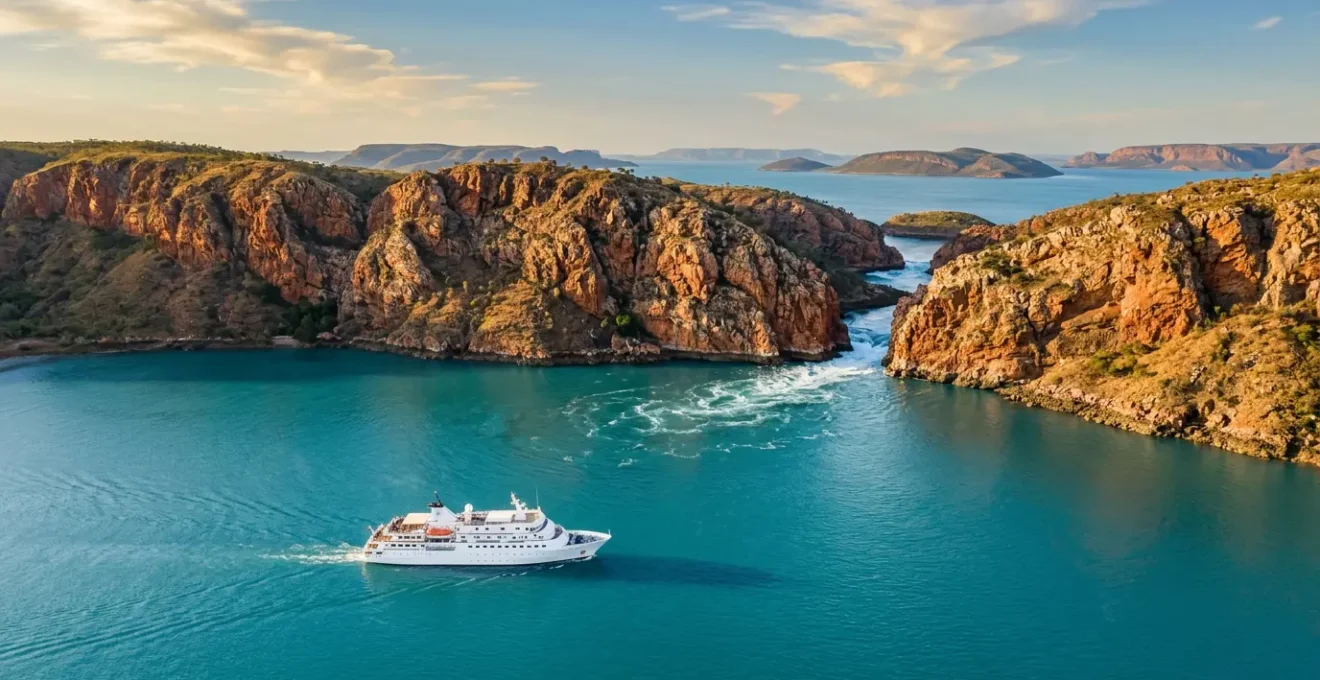
The £8,000 price tag for a Kimberley cruise is not an expense, but an investment in logistical supremacy and exclusive access that land-based travel cannot match.
- It buys direct, thrilling water access to tidal wonders like the Horizontal Falls, an experience physically inaccessible to 4WD vehicles.
- The cost covers complex logistics, including precisely timed waterfall visits, expert guides, and all necessary Indigenous land access permits.
Recommendation: For discerning travellers who value time, comfort, and guaranteed access to profound experiences over pure cost-saving, the expedition cruise delivers unparalleled and quantifiable value.
For the discerning traveller, the Kimberley region of Western Australia represents one of the planet’s last great wilderness frontiers. The debate often centres on the best way to conquer this vast landscape: a rugged 4WD adventure or a luxury expedition cruise. When faced with an £8,000 per person price tag for a cruise, the question of « worth » becomes paramount. Many analyses simply state that cruises are expensive but all-inclusive, a platitude that fails to address the core of the value proposition. They talk about the stunning scenery but don’t dissect the mechanics of accessing it.
But what if the £8,000 figure is misunderstood? What if it’s less a holiday expense and more a fee for unparalleled logistical supremacy? The true value of a Kimberley cruise doesn’t lie in the thread count of the sheets or the gourmet meals alone; it lies in its ability to solve the region’s greatest challenge: its brutal inaccessibility. It’s an investment in accessing the inaccessible, timing the untimeable, and experiencing a level of cultural depth that is simply unavailable to the independent traveller.
This analysis moves beyond the brochure to deconstruct that price tag. We will examine how the cost translates directly into tangible advantages, from superior access at key sites like the Horizontal Falls to the engineered timing of waterfall visits and the seamless navigation of complex Indigenous land permits. By framing the cost as an investment in experience, we can provide a definitive answer to whether this bucket-list journey is the right one for you.
To provide a clear cost-benefit analysis, this guide breaks down the key decision points and value drivers behind a luxury Kimberley expedition. Each section dissects a critical component of the trip, from logistics and timing to cultural engagement, to help you understand precisely what your investment delivers.
Summary: Deconstructing the Value of a Kimberley Cruise
- Cruise Ship vs 4WD Bus: Which Accesses the Horizontal Falls Best?
- Visiting Waterfalls: Why Is May Better Than September for Flow?
- Wet Landings Explained: What Footwear Do You Need for Zodiac Excursions?
- Permits and Passes: Do Luxury Tours Cover Indigenous Land Fees?
- Booking the Ghan Expedition: How Far in Advance Must You Secure a Cabin?
- Wine Tours vs Designated Driver: Is the £100 Tour Worth It?
- Why Are Indigenous Tours Often More Expensive Than Standard Tours?
- Authentic Indigenous Tours: How to Verify Aboriginal Ownership?
Cruise Ship vs 4WD Bus: Which Accesses the Horizontal Falls Best?
The Horizontal Falls, or « Horries, » are a natural phenomenon unique to the Kimberley. The spectacle is not a waterfall in the traditional sense, but a result of immense tidal power forcing its way through two narrow, staggered gorges of the McLarty Range. The central question for any traveller is not just seeing them, but experiencing their power. This is where the concept of logistical supremacy becomes clear. A 4WD bus can get you to a nearby airstrip for a scenic flight, but it cannot grant you passage *through* the falls themselves.
Expedition cruises offer an entirely different level of access. They position their high-powered Zodiac tenders to navigate the turbulent waters, allowing passengers to feel the phenomenal pull of the tide. This is made possible by the region’s incredible tidal movements, which can create a water level differential of up to 10 metres between the gorges. This immense natural force is the main attraction, and only a water-based approach can deliver this visceral experience. The cruise price effectively buys you a front-row seat to one of nature’s most powerful displays.
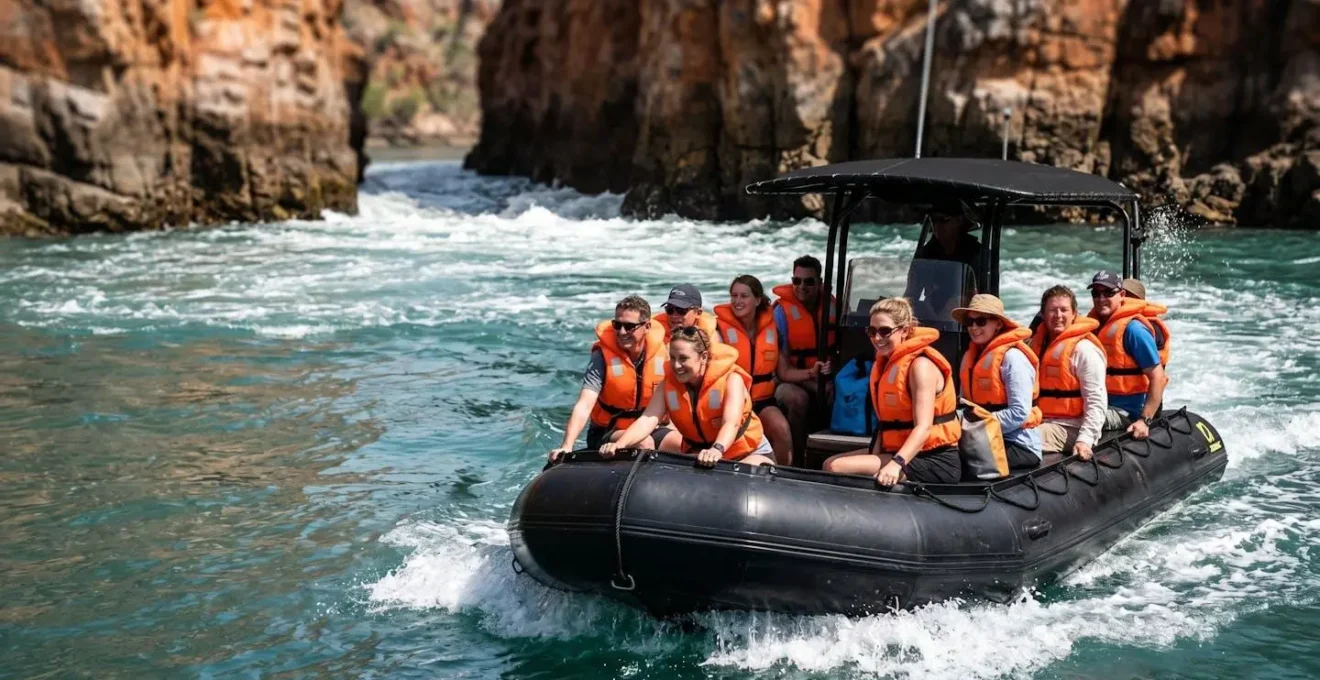
As the illustration demonstrates, the core of the Horizontal Falls experience is the intimate, dynamic encounter with the water. The £8,000 investment covers not only the Zodiac and its expert driver but also the complex positioning of the mother ship, which acts as a floating basecamp. This allows for multiple visits at different tides to witness the changing flow, a feat of scheduling and mobility that a land-based tour simply cannot replicate. The value is in the quality and intimacy of the access, not just a distant view from the air.
Visiting Waterfalls: Why Is May Better Than September for Flow?
The Kimberley’s waterfalls are a major drawcard, but their grandeur is entirely dependent on timing. The region has two distinct seasons: the wet (November to April) and the dry (May to October). While the wet season unleashes torrential rains that make travel nearly impossible, it is the crucial engine that feeds the landscape’s iconic falls. Visiting too late in the dry season can lead to disappointment, with mighty cascades reduced to a mere trickle.
Luxury cruises are masters of experience engineering, scheduling their itineraries to coincide with the optimal viewing window. They typically operate from April to September, but the early part of this window is when the magic happens. The land is still saturated from the wet season, and rivers and falls are at their most spectacular. As Tourism Australia, a leading authority on the region, advises, this timing is not a matter of luck but of deliberate strategy.
April and May are generally regarded as the best times to visit the Kimberley, as waterfalls are in full force after the wet season.
– Tourism Australia, Guide to Cruising the Kimberley Region
By September, many of the smaller falls have dried up completely, and even major arteries like King George Falls are significantly diminished. The premium price of a cruise in May is a direct reflection of this peak-season access. You are paying for the guarantee of witnessing the Kimberley at its most powerful and photogenic, a critical detail that transforms a good trip into an unforgettable one. It’s a calculated investment in seeing the landscape as it’s meant to be seen.
Wet Landings Explained: What Footwear Do You Need for Zodiac Excursions?
A core component of any Kimberley expedition cruise is the daily excursion via Zodiac tenders. These inflatable boats are the key to exploring hidden river systems, remote beaches, and ancient rock art sites. A common term you’ll encounter is « wet landing, » which is exactly what it sounds like: you will be stepping from the Zodiac into shallow water to get ashore. This has significant implications for what you need to pack, particularly your footwear.
Forget standard trainers or flip-flops. A wet landing requires a specialised footwear system. You need shoes that can get completely submerged, drain quickly, provide excellent grip on slippery rocks, and protect your feet from sharp shells or stones. The ideal solution is often a robust, closed-toe water sandal or a pair of amphibious hiking shoes. After the landing, you may be embarking on a hike to a waterhole or viewpoint, so comfort and support are non-negotiable. The right gear is essential for both safety and enjoyment, and expedition companies provide detailed guidance on this.
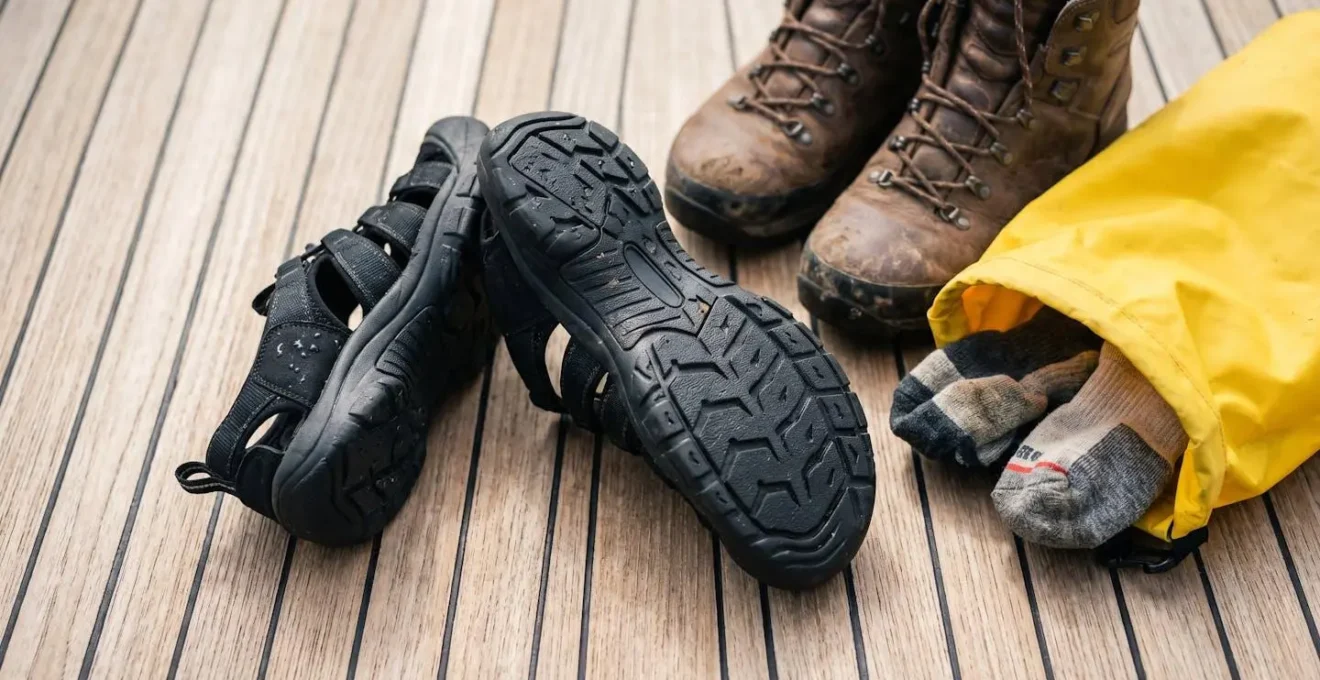
Beyond the right shoes, your entire excursion kit must be considered. While the cruise provides a high level of comfort, the Kimberley environment is demanding. Essential items for any Zodiac outing include:
- Quick-dry clothing: Synthetic fabrics are far superior to cotton in the humid conditions.
- Sun protection: A wide-brimmed hat and high-SPF sunscreen are mandatory.
- Insect repellent: Especially for excursions near mangroves or at dusk.
- Waterproof bag: A quality dry bag is vital for protecting cameras, phones, and other electronics from spray and during landings.
Permits and Passes: Do Luxury Tours Cover Indigenous Land Fees?
The Kimberley is not an empty wilderness; it is the ancestral home of numerous Aboriginal language groups, with a human history stretching back over 65,000 years. Much of the land accessed on a cruise is part of Native Title determinations or Indigenous Protected Areas. Accessing these culturally significant sites, from Gwion Gwion (Bradshaw) rock art galleries to sacred waterholes, is a privilege, not a right. It requires deep consultation, respect, and, crucially, a system of permits and fees.
This is a complex and sensitive administrative layer that is completely invisible to the passenger on a luxury cruise. The £8,000 price tag includes the cost of these access fees, which contribute directly to Traditional Owner corporations and communities. More importantly, it reflects the years of relationship-building and negotiation undertaken by the cruise operators to establish trust and secure permission. This represents a significant component of the trip’s « value density » – a hidden but vital service.
Reputable operators don’t just pay a fee; they build genuine partnerships. For example, premier cruise lines often formalise these relationships, as Seabourn has with the traditional owners of their primary operational area. They meet with the Wunambal Gaambera people, who are not only the custodians of the land but also act as « godparents » to the expedition ship, signifying a deep, ongoing collaboration. This ensures that visits are conducted respectfully and that a portion of the tourism revenue supports the preservation of culture and the economic well-being of the community. A 4WD tour operator or independent traveller would find navigating this landscape of permissions almost impossible.
Booking the Ghan Expedition: How Far in Advance Must You Secure a Cabin?
While The Ghan is a transcontinental train journey, its booking patterns provide a powerful parallel for understanding the demand and strategic planning required for a Kimberley cruise. Both are iconic, high-demand Australian bucket-list experiences that sell out far in advance. For affluent retirees and milestone travellers, these trips are often planned years, not months, ahead of time. Waiting until the last minute is not an option.
Premium Kimberley cruise operators often report that their most popular dates are fully booked 18-24 months in advance. This long lead time is driven by the short operational season (April-September) and the small number of vessels with the necessary permits and shallow-draft design to navigate the region. Cabins are a scarce and highly sought-after commodity. The question is not just *how far* in advance to book, but *how to sequence* these major trips if you plan to do more than one.
Case Study: Journey Beyond’s Integrated Itinerary Strategy
Journey Beyond, operator of The Ghan and Indian Pacific, offers integrated packages that combine their rail journeys with Kimberley expeditions. Their « Perth & Horizontal Falls Adventure » package for 2026 illustrates a key strategy: experience the high-adventure Kimberley cruise component first, then unwind on the luxury train journey. This sequencing allows travellers to tackle the more physically active part of their holiday (Zodiac rides, wet landings, hikes) while they are fresh, followed by a relaxing, all-inclusive rail experience. The package demonstrates the intricate logistical planning involved, including transfers between cruise ports and train terminals, highlighting the value of a single, trusted operator handling all components.
The key takeaway is that securing a place on a top-tier Kimberley cruise requires a strategic, long-term approach. The high price tag is partly a function of this extreme scarcity. Just as with The Ghan’s Platinum Service cabins, you are paying for a coveted spot in a very limited inventory, and planning must begin at least two years out to secure your preferred ship and itinerary.
Wine Tours vs Designated Driver: Is the £100 Tour Worth It?
At first glance, a wine tour in the Barossa Valley seems unrelated to a Kimberley expedition. However, the decision-making process offers a perfect analogy for the « Cruise vs. 4WD » debate: is a curated, expert-led experience worth the premium over a self-managed alternative? A £100 guided wine tour might seem expensive when a designated driver could facilitate a « free » day of tastings. The value, as with the Kimberley cruise, is in the access and expertise that money buys.
A designated driver can get you to the public cellar doors of well-known wineries. A professional guide, however, unlocks a hidden layer of the region. They have personal relationships with winemakers, granting access to private tastings, back-vintage wines not available to the public, and behind-the-scenes tours of the barrel rooms. The experience is transformed from a series of disconnected transactions into a cohesive, educational narrative. The same principle applies to the Kimberley. A 4WD can get you to a public lookout; a cruise’s expedition team provides the geological, historical, and cultural context that brings the landscape to life.
The table below breaks down this value proposition, which can be directly mapped onto the Kimberley cruise analysis. The « Guided Tour » represents the cruise, while the « Self-Drive » represents the 4WD option.
| Factor | Guided Wine Tour (£100) | Self-Drive with Designated Driver |
|---|---|---|
| Access Level | Private tastings, winemaker meetings, back-vintage access, museum wines | Public cellar door tastings only |
| Experience Quality | Curated narrative connecting geology, history, personalities; educational storytelling | Series of disconnected tastings; self-guided research required |
| Hidden Costs | All-inclusive: transport, tastings, guide expertise | Fuel, parking, driver’s compromised experience (no tasting), route planning time |
| Discovery Potential | Access to small hidden-gem wineries known to local guides | Limited to wineries found via online research; risk of missing best small producers |
| Group Size | Typically 8-12 guests allowing intimate conversations | Dependent on vehicle capacity |
| Convenience | Door-to-door service, no navigation stress | Driving navigation, parking challenges, time management responsibility |
Key Takeaways
- Access is Value: The cruise price buys direct, physical access to phenomena like the Horizontal Falls, which is impossible for land-based tours.
- Timing is Everything: You are paying for a guaranteed peak-season experience, witnessing waterfalls at their most powerful in April and May.
- Expertise is Inclusive: The cost covers not just guides, but also the complex, behind-the-scenes negotiation of Indigenous land permits and partnerships.
Why Are Indigenous Tours Often More Expensive Than Standard Tours?
A significant and deeply enriching component of a modern Kimberley cruise is the opportunity for authentic Indigenous cultural experiences. Travellers may notice that tours led by Aboriginal guides often come at a premium compared to standard sightseeing excursions. This price difference is not arbitrary; it reflects a unique and more complex value proposition rooted in authenticity, cultural integrity, and sustainable community development.
Firstly, there is immense demand for genuine cultural connection. Prior to the global travel downturn, tourism authorities noted that 1.4 million international visitors (17%) participated in an Aboriginal tourism experience, demonstrating a clear market desire. This demand is for something more than just looking at rock art; it’s about hearing the stories behind it from a traditional custodian. This intellectual and cultural property has immense value. As global bodies have noted, this is a market segment willing to invest in meaningful travel.
Visitors looking for environmental and culturally differentiated destinations are eager to spend more money for these experiences.
– UNEP (United Nations Environment Programme), Sustainable Tourism Development Report
Secondly, the higher cost supports a more sustainable and ethical tourism model. It enables smaller group sizes, which minimizes environmental impact on sensitive sites and allows for more intimate, personal interaction with the guide. A portion of the revenue is often reinvested into the community, funding language preservation programs, training for younger guides, and the maintenance of cultural centres. Therefore, the premium price is an investment in the preservation of the very culture you have come to experience, ensuring it remains vibrant for generations to come.
Authentic Indigenous Tours: How to Verify Aboriginal Ownership?
For the conscientious traveller, ensuring that your tourism dollars support genuinely Aboriginal-owned and operated businesses is paramount. The term « Aboriginal experience » can be used loosely, and it’s important to distinguish between a company that employs an Indigenous guide versus one that is 100% Aboriginal-owned and directed. The latter ensures that the benefits—both economic and in terms of cultural empowerment—flow directly back to the community.
Verifying authenticity requires a bit of due diligence before you book. Vague marketing language like « in consultation with local people » can be a red flag. You should look for clear, unambiguous statements of ownership. Reputable national bodies and regional councils provide accreditation that serves as a reliable stamp of approval. For instance, the Tourism Australia’s Discover Aboriginal Experiences is a collective of over 160 quality, authentic guided tourism offerings, providing a pre-vetted list for travellers. In Western Australia, accreditation from an organisation like WAITOC (Western Australian Aboriginal Tourism Operators Council) is a gold standard.
To ensure your investment is making a positive impact, it is crucial to apply a verification framework to any potential tour operator. The following checklist provides a simple, effective method for assessing the authenticity of an Aboriginal tourism experience.
Your Action Plan: Verifying Authentic Aboriginal Tourism
- Scrutinise the ‘About Us’ Page: Look for specific Traditional Owner family names or clear statements like « 100% Aboriginal-owned and operated. » Be wary of vague phrases that suggest consultation rather than ownership.
- Look for Accreditation Logos: Check for official logos from recognised bodies such as the Western Australian Aboriginal Tourism Operators Council (WAITOC) or the national « Discover Aboriginal Experiences » certification on the operator’s website.
- Assess the Specificity of Storytelling: Verify that the operator tells a specific story tied to their Nation (e.g., Bardi, Bunuba). Generic « Aboriginal » content can indicate a lack of deep, authentic cultural connection to that specific Country.
- Investigate Community Integration: Examine the operator’s social media and blog for evidence of genuine community involvement, such as photos from local events, use of traditional language, and stories that reflect ongoing relationships.
- Review Strategic Documents: If available, read the operator’s Reconciliation Action Plan (RAP). Search their site for details on partnerships, such as guide training programs or support for community-run art centres, which demonstrate a real commitment.
Ultimately, the decision to invest £8,000 in a Kimberley cruise hinges on your personal definition of value. If your priority is simply to tick a box at the lowest possible cost, a 4WD trip may suffice. However, if value is measured in terms of exclusive access, logistical peace of mind, expert enrichment, and guaranteed peak experiences, the expedition cruise presents a compelling, and arguably unparalleled, proposition. To make the best decision for your bucket list, the next step is to honestly assess your own travel priorities against the distinct benefits a luxury cruise provides.