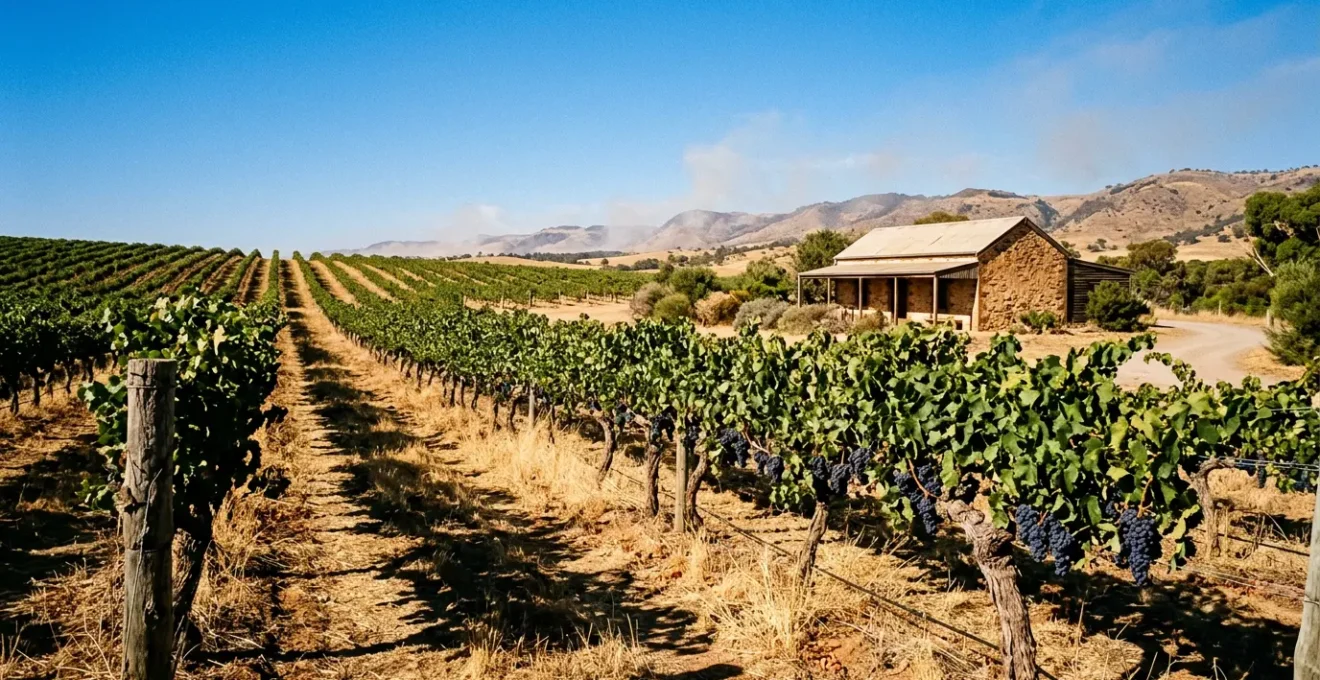
The secret to enjoying Barossa’s iconic red wines in extreme summer heat is not to avoid them, but to master the environment with a winemaker’s strategy.
- Utilise « strategic cooling » by chilling big reds to a perfect 16-18°C, transforming them from heavy to refreshing.
- Leverage the « thermal mass » of historic stone buildings and plan your day around natural « heat refuges » for midday breaks.
- Shift outdoor activities like cycling to a « dawn patrol » schedule (6-8am) before the sun’s intensity peaks.
Recommendation: Think like a local. Instead of fighting the heat, use it as a reason to slow down, plan strategically, and discover the cool, quiet moments the Barossa offers between its sun-drenched vines.
The first blast of 40-degree air that hits you when you step out of the car in a Barossa summer can be confronting. The air shimmers over the tarmac, and the sun has a physical weight to it. Your immediate thought is likely, « How on earth am I supposed to drink a big, bold Shiraz right now? » It’s the region’s great paradox. We’re world-famous for powerful red wines, yet our summers can feel more suited to an ice-cold beer. Most travel guides offer the standard advice: stick to Riesling, stay indoors, and drink lots of water. While sensible, that advice misses the entire point of your visit – to experience the heart and soul of Australian Shiraz, right where it’s born.
As a winemaker who lives and breathes this climate, I can tell you there’s a better way. The solution isn’t to surrender to the heat; it’s to outsmart it. It requires a shift in mindset, from seeing the heat as an obstacle to viewing it as a parameter to be managed. This isn’t about just finding air-conditioning; it’s about understanding the physics of strategic cooling, the architectural intelligence of our settler history, and the rhythm of the valley. It’s about knowing when to move, when to be still, and exactly how a 16°C glass of Cabernet can be the most refreshing thing you taste all day, even when the mercury climbs.
This guide is your insider’s manual for not just surviving, but thriving during a Barossa heatwave. We’ll move beyond the obvious tips and give you the specific, actionable strategies locals use. We’ll cover how to time your visits to iconic spots, whether cycling is truly feasible, and what those « Ancestor Vine » labels really mean for a wine’s resilience. You will learn to see the valley not as a furnace to be endured, but as a landscape of opportunities, with cool refuges and perfectly timed moments of pleasure waiting to be discovered.
This article provides a detailed roadmap for your summer visit. Below is a summary of the key strategies and insights we will explore to help you master the art of enjoying the Barossa Valley, even on its hottest days.
Summary: A Winemaker’s Guide to the Barossa in Summer
- Maggie Beer’s Farm Shop: When Is the Best Time to Avoid the Crowds?
- Cycling the Barossa: Is It feasible to Ride Between Wineries in the Heat?
- Old Vine Charter: What Does « Ancestor Vine » Actually Mean on the Label?
- German Heritage: Why Are There So Many Bakeries in the Barossa?
- Heritage Cottages: How to Book a Stay in an 1850s Stone Miner’s Cottage?
- Why Is Australian Sun So Much Stronger Than in the Mediterranean?
- Heat Stroke vs Heat Exhaustion: When Should You Call the Flying Doctor?
- Penfolds Grange: Is the 2018 Vintage Worth the £500 Investment?
Maggie Beer’s Farm Shop: When Is the Best Time to Avoid the Crowds?
Maggie Beer’s Farm Shop is a Barossa institution, a non-negotiable stop for many visitors. But on a 40°C day, its popularity can lead to crowds, turning a pleasant visit into a sweltering shuffle. The key is strategic timing. Most visitors operate on a standard tourist schedule, arriving mid-morning after breakfast or in the early afternoon after a winery visit. This creates a peak rush between 11 am and 2 pm, precisely when the sun is fiercest and the car park offers little shade.
To beat both the heat and the crowds, aim for one of two windows. The first is right at opening. Be there at 10 am, and you’ll enjoy a relatively quiet shop, easy parking, and the chance to browse the pates, jams, and ice creams in cool comfort. The second, and arguably better, strategy is the late-afternoon visit. Arrive around 3:30 pm. By this time, the tour buses have departed, and the lunchtime rush is a distant memory. The intense heat of the day has begun to subside, and you can often find a shaded table by the pond to enjoy a coffee or a final taste of the day.
This late-afternoon approach allows you to use the hottest part of the day for a seated, air-conditioned wine tasting or a long lunch elsewhere, and then cap off your day at the Farm Shop as things are winding down. It’s a simple switch, but it transforms the experience from a stressful peak-hour rush to a relaxed, civilised pleasure. Remember to check their schedule, as the shop is open 7 days from 10 am to 4:30 pm but closes on major public holidays, which can affect your plans during the Christmas and Easter summer breaks.
Cycling the Barossa: Is It feasible to Ride Between Wineries in the Heat?
The idea of cycling from cellar door to cellar door is romantic, but the reality of a 40°C day can make it seem impossible, even dangerous. However, with the right strategy and equipment, it is not only feasible but one of the best ways to experience the valley’s beauty. The secret is to abandon the idea of a full-day cycling tour and embrace two key concepts: the e-bike and the « dawn patrol ».
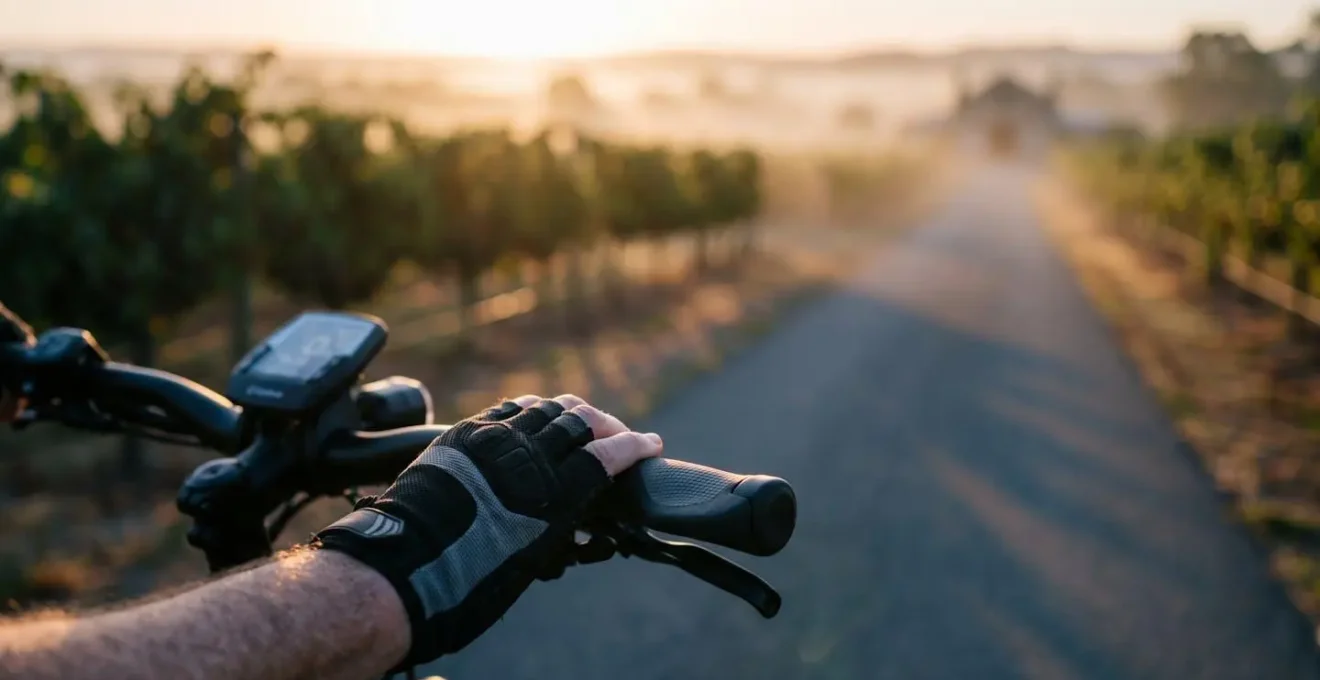
An e-bike is a game-changer. It minimizes physical exertion, which is critical for reducing the risk of heat exhaustion. The electric assist does the hard work, allowing you to enjoy the scenery without overheating. Pair this with a « dawn patrol » schedule. Get out on the trail between 6 am and 8 am. The air is cool, the light is golden, and you’ll have the paths almost to yourself. This is your time for scenic riding, not wine tasting. After your ride, you switch to a car for midday tastings when the heat is at its peak. This hybrid approach gives you the best of both worlds.
When planning your route, think in micro-loops. Instead of long, ambitious rides across the valley’s 40km trail network, focus on short 2km hops between wineries on a concentrated strip like Seppeltsfield Road. These are manageable 10-minute rides, even in warmer temperatures. Always prioritise hydration; carry extra water and make use of the bottle cages and saddle bags provided with most rentals. Choosing an e-bike isn’t just about comfort; it’s a crucial heat management tool that makes cycling in the Barossa summer a genuine pleasure.
Old Vine Charter: What Does « Ancestor Vine » Actually Mean on the Label?
You’ll see terms like « Old Vine, » « Centenarian, » and « Ancestor » on Barossa wine labels, but they are more than just marketing jargon. They represent a formal classification from our Old Vine Charter, a world-first initiative to register and preserve our irreplaceable viticultural heritage. Understanding these tiers is key to understanding the intensity and character of the wine in your glass, especially in the context of summer heat.
Older vines are, by nature, more resilient to drought and heat. Their incredibly deep root systems can find water far below the surface, allowing them to survive and ripen fruit evenly during the scorching heatwaves that younger vines struggle with. This survival instinct is reflected in the wine: a remarkable concentration of flavour, structure, and balance. Here’s what the classifications signify:
- Old Vine (35+ years): These are mature vines that have hit their stride, producing wines with excellent flavour and consistency.
- Survivor Vine (70+ years): These vines pre-date the 1980s vine-pull scheme, a testament to their inherent quality and resilience. The wines show more structure and depth.
- Centenarian Vine (100+ years): From thick, gnarled trunks, these vines produce very low yields of intensely flavoured grapes, resulting in wines of exceptional power and complexity.
- Ancestor Vine (125+ years): These are living monuments, some of the oldest producing grapevines on the planet. According to the official Barossa Old Vine Charter, these vines are dry-grown, with fruit that offers extraordinary concentration and a story that connects directly back to the 1840s.
Case Study: Tasting History at Elderton and Henschke
The difference becomes tangible when you visit a cellar door like Elderton. Their Command Shiraz comes from Ancestor Vines planted in 1894, which you can physically stand beside. Tasting the wine while looking at the 130-year-old vine that produced it creates a profound connection. You can taste the depth and the long, subtle tannins that are a hallmark of these ancient plants. Similarly, Henschke’s iconic Hill of Grace is sourced from Ancestor Vines that have witnessed over a century of winemaking history, offering a direct link from the gnarled trunk in the vineyard to the complex wine in your glass.
German Heritage: Why Are There So Many Bakeries in the Barossa?
The abundance of bakeries and butcher shops is a delicious and defining feature of the Barossa landscape. This culinary identity is a direct legacy of the Prussian Silesian settlers who fled religious persecution and arrived here in the 1840s. They brought with them their Lutheran faith, their agricultural skills, and their cherished food traditions. Towns like Tanunda became cultural hubs, so much so that it’s often recognized as the most German of the Barossa’s towns, where German was the primary language well into the 20th century.
These traditions offer a fantastic strategy for beating the summer heat. The German custom of « Kaffee und Kuchen » (coffee and cake) is a perfect mid-afternoon ritual. Instead of a heavy, hot lunch, you can retreat into an air-conditioned bakery like Tanunda Bakery or Linke’s for a slice of streuselkuchen or bienenstich (bee sting cake). These bakeries become welcome « heat refuges » during the hottest part of the day.
This heritage also provides an intelligent solution for evening meals. On a 40°C day, the last thing you want is to turn on an oven or stand over a hot BBQ. Instead, visit one of the local German butcher shops (‘Fleischer’). Here you can buy Lachsschinken (a cold-smoked, cured pork loin) and various types of Mettwurst (cured sausage). Paired with some fresh sourdough from a local bakery, you have the makings of a perfect, effortless summer platter to be enjoyed on your cool veranda as the evening breeze rolls in. This is not just a meal; it’s an authentic taste of Barossa’s living history.
Heritage Cottages: How to Book a Stay in an 1850s Stone Miner’s Cottage?
Choosing the right accommodation is critical to mastering a Barossa summer, and the region’s heritage cottages offer a unique, built-in advantage. These 1850s stone miners’ cottages are not just charming; they are a masterclass in passive cooling. The secret lies in their construction: thick, solid stone walls that possess a high thermal mass. This means they absorb the day’s heat very slowly, keeping the interior surprisingly cool during the hottest hours (typically 12 pm to 4 pm). Then, as the evening cools, they slowly radiate that stored warmth back, creating a comfortable ambient temperature overnight.
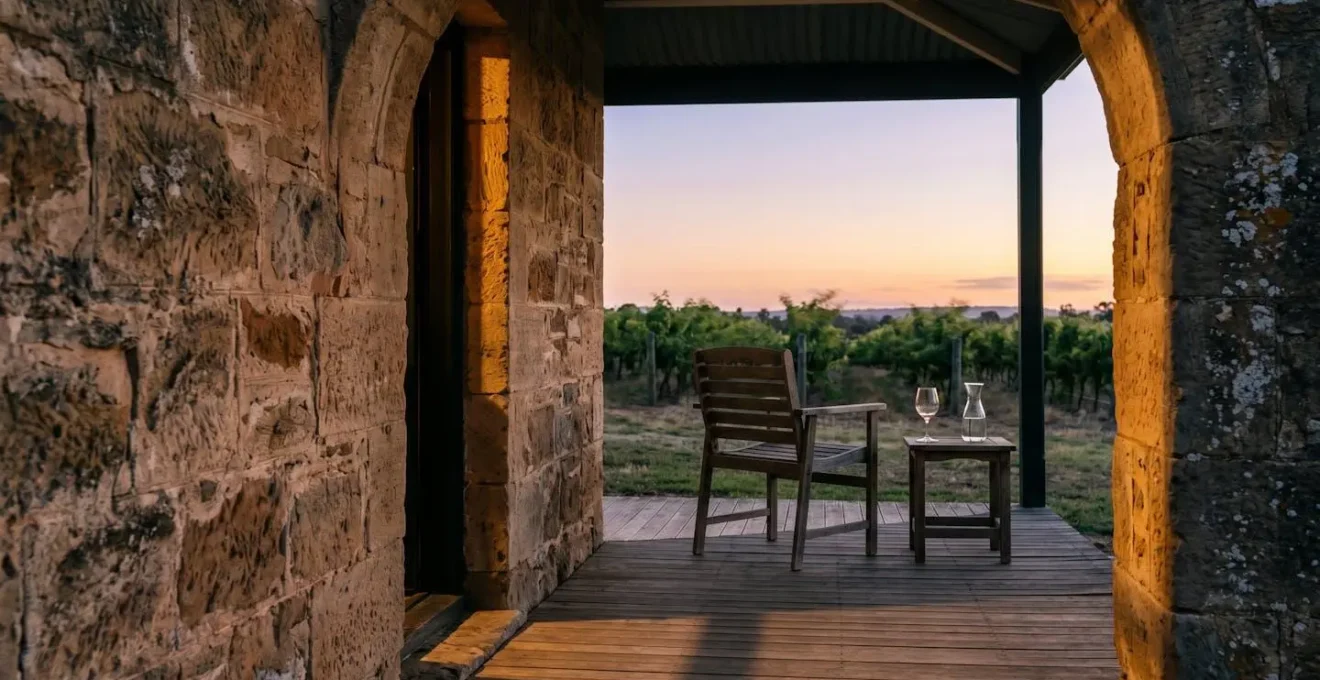
This natural climate control makes for the perfect summer evening ritual. Imagine enjoying a world-class Barossa Shiraz, cooled to a perfect 18°C in your own kitchen, while sitting on the private veranda of your cottage as the « gully breeze » rolls in after sunset. This is an experience a standard hotel room simply cannot replicate. While resort pools are an option, they are often crowded on hot days. A heritage cottage offers a secluded, private space for true relaxation.
To find and book these properties, a great starting point is the official tourism website, Barossa.com. Use search filters like « cosy cottages » and « self-contained retreats, » and look for properties described as historic or stone-built. Booking directly often yields the best results, especially if you plan your visit outside the absolute peak holiday periods of Christmas and Easter. This hybrid strategy of using the cottage for its natural evening cooling while perhaps locating a nearby public pool for a strategic midday swim offers the ultimate heat-beating accommodation plan.
Why Is Australian Sun So Much Stronger Than in the Mediterranean?
Many visitors from the Northern Hemisphere are shocked by the sheer intensity of the Australian sun. They assume a 40°C day here is the same as a 40°C day in Greece or Italy, but it feels fundamentally different—and it is. As a region with a Mediterranean-like climate of hot, dry summers, the difference isn’t the temperature itself, but the ferocity of the ultraviolet (UV) radiation. This isn’t just a feeling; it’s based on science.
A common myth is that this is due to the ozone hole, but the hole is primarily over Antarctica. The real reasons are more specific to Australia’s place on the globe. Firstly, during our summer (December to February), the Earth’s elliptical orbit brings the Southern Hemisphere closer to the sun than the Northern Hemisphere is during its summer. This proximity increases the intensity of solar radiation. Secondly, Australia’s atmosphere is generally cleaner and less polluted. While this is great for air quality, it means there are fewer particles in the air to scatter and absorb UV rays, allowing more of them to reach the ground directly.
The practical implication for your visit is crucial: the UV index can reach « Extreme » levels as early as 10 am, long before the day’s temperature peaks around 2 or 3 pm. This means sun protection isn’t optional; it’s mandatory even for a short walk from your car to a cellar door. You must apply SPF 50+ sunscreen before you even leave your accommodation, reapply it every two hours, and always wear a wide-brimmed hat and sunglasses. Between 10 am and 4 pm, seeking shade is not a suggestion, it’s a survival strategy.
Heat Stroke vs Heat Exhaustion: When Should You Call the Flying Doctor?
In the Barossa’s summer heat, it’s vital to distinguish between feeling a bit faint after a wine tasting and experiencing a serious medical emergency. Alcohol and heat are a dangerous combination. Alcohol acts as a diuretic, accelerating dehydration, and as a vasodilator, which hampers your body’s ability to regulate its own temperature. This is the alcohol’s heat multiplier effect, and it means the risk of heat-related illness is significantly higher during a day of wine tasting.
You need to be able to spot the difference between heat exhaustion and the far more dangerous heat stroke. Heat exhaustion is your body’s warning signal that it’s struggling. Heat stroke is a life-threatening failure of that system. One common misconception for tourists is who to call. The Royal Flying Doctor Service (RFDS) is an iconic Australian institution, but it serves the remote outback. In the Barossa, you call 000 for an ambulance. The nearest hospital is the Tanunda Hospital on Barossa Valley Way.
Knowing the signs and acting immediately is critical. If you or someone in your group feels unwell, don’t just « push through. » Stop, find shade, hydrate, and assess the symptoms immediately.
Your Heat Illness Symptom Checklist
- Assess Dizziness: If you feel dizzy after a tasting, immediately drink a full glass of water. If dizziness persists after 15 minutes in a cool spot, suspect heat exhaustion.
- Check for Heat Exhaustion: Symptoms include heavy sweating, weakness, cold/clammy skin, a fast but weak pulse, nausea, and fainting. This is serious. Immediately move the person to air-conditioning, have them sip water, and apply cool, wet cloths.
- Identify Heat Stroke (EMERGENCY): The key difference is the skin. If someone has hot, dry skin (they’ve stopped sweating), a rapid and strong pulse, is confused, or loses consciousness, this is a medical emergency.
- Take Immediate Action: For heat stroke, call 000 for an ambulance without delay. This condition can cause permanent damage or death if not treated immediately.
- Review Your Day: Remember that alcohol significantly increases your risk. A good rule is to drink at least one full glass of water for every glass of wine you taste.
Key Takeaways
- Mastering a Barossa summer is about strategy, not avoidance; chill your reds to 16-18°C for a refreshing experience.
- Plan your day around « heat refuges » like historic bakeries and use the « thermal mass » of stone cottages for natural cooling.
- Prioritise safety by understanding the signs of heat exhaustion vs. heat stroke and knowing that the emergency number is 000, not the Flying Doctor.
Penfolds Grange: Is the 2018 Vintage Worth the £500 Investment?
The question of whether to taste Penfolds Grange on a Barossa trip is a common one, especially with a price tag that can be north of £500. On a hot summer’s day, this decision becomes even more complex. The answer lies in reframing the question: instead of « Is the wine worth it? », ask « Is the *experience* worth it as a heat-beating strategy? » When you look at it this way, the « Taste of Grange » experience becomes a very attractive proposition.
This is not a stand-up tasting at a crowded bar. It is a premium, seated, fully climate-controlled activity. It offers 1-2 hours of luxurious, cool refuge during the absolute peak of the afternoon heat. From this perspective, you are not just paying for a taste of an iconic wine; you are investing in an exclusive, comfortable, and educational shelter from the 40°C sun. For many, that added value justifies the cost. You can have this experience at either the Penfolds Barossa Valley Cellar Door in Tanunda or the historic Magill Estate near Adelaide, with the Barossa location offering the full regional context.
However, it’s also worth considering the opportunity cost. That same £500 could alternatively fund an entire day with a private driver (the ultimate air-conditioned convenience), a mixed case of other premium Barossa wines to take home, and a multi-course dinner at one of the region’s top restaurants. A smart alternative is to book a standard tasting at Penfolds to soak in the atmosphere, then invest the rest of your budget in a wider range of experiences across the valley’s over 150 wineries. Ultimately, the « Grange question » is a personal one, but viewing it as an experiential investment in comfort can make the decision much clearer.
With these strategies in hand, you are no longer a tourist at the mercy of the weather, but an informed visitor ready to unlock the very best of the Barossa. The next logical step is to start piecing together your own heat-smart itinerary. Begin by choosing your must-visit wineries and then build your day around them using the timing and cooling principles we’ve discussed.