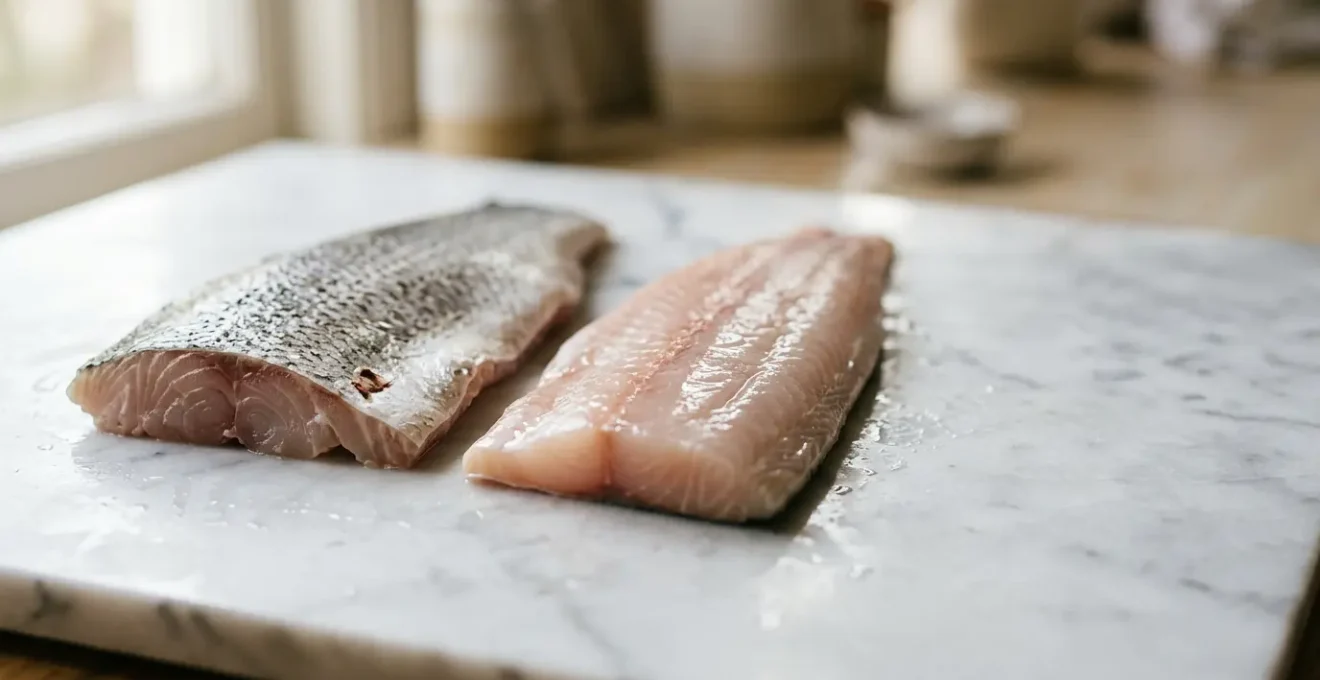
The « muddy » taste of some barramundi isn’t an accident; it’s a direct result of its environment, a concept chefs refer to as the « terroir » of the water.
- Wild, saltwater barramundi has a cleaner, more mineral flavour and firmer texture due to its varied diet and the biological stress of living in the ocean.
- Farmed, freshwater barramundi often tastes « earthy » due to compounds like geosmin in its environment, and has a softer texture.
Recommendation: When buying barramundi, always ask your fishmonger about its origin—wild-caught from the ocean or saltwater farms will deliver the premium, clean flavour you’re looking for.
You bring home a beautiful barramundi fillet, cook it perfectly, but the first bite is a letdown. Instead of a clean, sweet flavour, you get a distinct, almost « muddy » or earthy taste. It’s a common frustration for seafood lovers and a question I hear often in my kitchen. The simple answer you’ll often hear is that it’s a difference between wild and farmed fish, or saltwater versus freshwater. While true, this barely scratches the surface.
As a chef, I don’t just see two types of fish; I see two completely different stories. The taste of a barramundi isn’t just a characteristic; it’s a detailed record of its life. It’s a story told through its diet, the salinity of the water it swam in, and even the biological processes happening at a cellular level. The drastic difference in flavour is not about one being « good » and the other « bad, » but about understanding the unique « terroir » of the water and how it shapes the final product on your plate.
Forget the simple explanations. We are going to deconstruct the barramundi’s flavour profile from the source. We will explore how its environment dictates texture, how its life cycle influences its quality, and what specific chemical compounds create the flavours you taste. This is the chef’s guide to truly understanding one of Australia’s most iconic fish.
This guide breaks down every aspect that contributes to the barramundi’s final flavour and texture, from its life in the wild to its place in modern Australian cuisine. Explore the sections below to become an expert in choosing the perfect fillet.
Summary: A Chef’s Guide to Barramundi’s True Flavour
- Barramundi Season: When is the Closed Season in the Northern Territory?
- Saltwater vs Freshwater: Which Barramundi Fillet Has Better Texture?
- Crispy Skin: How to Stop Barramundi from Sticking to the Pan?
- Gender Changing Fish: How Does a Barramundi Become Female?
- Fishing Safety: Why Should You Never Stand at the Water’s Edge in the Top End?
- Oysters and Finger Lime: Why Is This the Ultimate Australian Pairing?
- Modern Australian Cuisine: How Did « Mod Oz » Blend Asian and European Flavours?
- Urban Foraging: Can You Eat the Berries in Your Melbourne Airbnb Garden?
Barramundi Season: When is the Closed Season in the Northern Territory?
Understanding the seasonality of wild barramundi is the first step to appreciating its quality. Like any premium, wild-harvested product, there is a right time to source it. Closed seasons are not arbitrary; they are critical conservation measures put in place to protect the species during its spawning periods. This ensures the long-term health of the fish population and, by extension, the quality of the fish available in the future.
In Australia’s Top End, the home of iconic wild barramundi, the fishing season is carefully managed. For commercial operations in the Northern Territory, the open season runs from 1 February to 30 September annually. This period avoids the crucial summer wet season when barramundi aggregate to spawn, often at the mouths of rivers. Respecting this cycle is fundamental to sustainable fishing.
These dates can vary by region, reflecting different environmental cues and spawning times. For instance, the barramundi spawning closure on Queensland’s east coast runs from the 1st of November to the 31st of January. As a chef, knowing these seasons is crucial. Sourcing wild barramundi during the open season means you are getting a fish that has been harvested responsibly, outside of its vital breeding window, which often correlates with a fish in peak condition.
Saltwater vs Freshwater: Which Barramundi Fillet Has Better Texture?
Here we arrive at the heart of the matter: the water. The difference in texture between a saltwater and a freshwater barramundi is not just a matter of opinion; it’s a biological fact rooted in a process called osmoregulation. This is how a fish controls the balance of salt and water within its body. In a high-salinity marine environment, the fish must constantly work to expel salt and retain water. This constant physiological work results in leaner, more defined muscle fibers.
As the team at Wildman Fishing Tours notes, this has a direct impact on the eating experience. They observe that « wild-caught barramundi is generally a saltwater fish and has a much firmer and flakier flesh ». This firmness is what chefs prize. It allows the fillet to hold together during cooking and gives it a satisfying, meaty bite that flakes into succulent pieces. In contrast, fish from a low-salinity or freshwater environment have a much easier time with osmoregulation, leading to softer, less dense muscle tissue, which can sometimes be described as « mushy ».
This microscopic view of the gill tissue shows the complex cellular machinery—the chloride cells—that a barramundi uses to manage this salt exchange. The intense energy required for this process in saltwater literally tones the fish’s muscles, creating that superior texture. So, when you choose a saltwater barramundi, you are choosing a fish that has had a lifetime of « working out, » resulting in a firmer, more premium fillet.
Crispy Skin: How to Stop Barramundi from Sticking to the Pan?
There are few things more satisfying than perfectly crispy fish skin, and barramundi skin is one of the best. The secret to achieving that perfect crisp without it sticking to the pan lies less in complex techniques and more in understanding the properties of the fillet you’re working with. The fat content and skin quality are directly linked to the fish’s origin.
As noted by Australis Aquaculture, a leader in sustainable ocean-farming, their « ocean-farmed barramundi has a clean, buttery flavor with a succulent and firm texture. It offers a silky mouthfeel and a delicate skin that crisps perfectly when seared. » This highlights a crucial point: a high-quality fish with good fat content under the skin is your greatest asset. This fat not only carries flavour but also acts as a natural barrier between the delicate skin and the hot pan, helping it to release and crisp up beautifully.
The enemy of crispy skin is moisture. A wet fillet will steam rather than sear, causing it to stick. Whether your fillet is wild or sustainably farmed, the preparation is key. A dry surface is non-negotiable. Combined with a properly heated pan and the right amount of high-smoke-point oil, you create the ideal conditions for the Maillard reaction to occur, giving you that golden-brown, crispy result every single time.
Your Action Plan: The Chef’s Method for Perfect Crispy-Skin Barramundi
- Pat the Fish Dry: Use paper towels to pat the entire fillet, especially the skin side, until it is completely dry to the touch. Let it sit on the paper towel for a few minutes in the fridge to air-dry further if you have time.
- Season Just Before Cooking: Season the skin side with fine sea salt right before it goes into the pan. Salt draws out moisture, so doing it too early will make the skin wet again.
- Get the Pan Hot: Place a heavy-bottomed pan (like cast iron or stainless steel) over medium-high heat. The pan is hot enough when a drop of water sizzles and evaporates instantly.
- Oil and Place: Add a thin layer of a high-smoke-point oil (like grapeseed or canola). Gently place the fillet in the pan, skin-side down, laying it away from you to avoid splashes.
- Press and Hold: As soon as the fish hits the pan, use a fish spatula to press down firmly on the fillet for 10-15 seconds. This prevents the skin from curling and ensures even contact with the pan for a uniform crust.
Gender Changing Fish: How Does a Barramundi Become Female?
Beyond flavour and texture, the barramundi possesses another fascinating trait: it’s a protandrous hermaphrodite. This is a biological term meaning they change gender from male to female as they grow. This isn’t a rare occurrence; it’s a fundamental part of their life cycle. As Wikipedia contributors summarize, « most individuals maturing as males and becoming female after at least one spawning season; most of the larger specimens are therefore female. »
This process is driven by a combination of age, size, and social cues. In essence, a barramundi will spend the early part of its life as a functional male. Once it reaches a certain size and maturity, typically after participating in at least one spawning event, a hormonal shift is triggered, and the fish transitions into a female for the remainder of its life. This strategy ensures that the largest, most robust individuals in the population—those that have proven their fitness by surviving to a large size—are the ones responsible for producing eggs, maximizing the chances of reproductive success.
This biological imperative has interesting implications for anglers and chefs. The coveted « trophy » barramundi, the metre-plus giants, are almost exclusively female. This gender change is not just a curiosity; it’s a key factor in the species’ resilience, and recent science shows it’s linked to their early life conditions.
Case Study: Fast Growth Leads to Earlier Sex Change
A fascinating 2021 study in Scientific Reports delved into this phenomenon. By analysing the otoliths (ear bones) of wild barramundi, researchers discovered a direct link between a fish’s growth rate as a juvenile and the timing of its sex change. The study found that fish with faster juvenile growth rates transitioned from male to female at an earlier age. These fast-growing individuals ultimately became larger females, making them disproportionately important to the overall fecundity of the population. This shows that the conditions a barramundi experiences early in life are a powerful predictor of its later reproductive fitness as a female.
Fishing Safety: Why Should You Never Stand at the Water’s Edge in the Top End?
The « terroir » that produces the superior flavour of wild barramundi is an untamed, powerful environment. Part of appreciating a wild-caught fish is respecting the ecosystem it comes from, and in Australia’s Top End, that means being acutely aware of its apex predator: the saltwater crocodile. The pristine rivers and estuaries teeming with barramundi are also the prime habitat for one of the most dangerous animals on the planet.
The danger is not an exaggeration; it is a statistical reality. The Northern Territory is home to a thriving population of approximately 100,000 saltwater crocodiles (excluding hatchlings), with an average density of five crocodiles per kilometre of waterway. They are masters of ambush, often lying motionless and almost invisible at the water’s edge. The local rule is simple and absolute: if you cannot see the bottom, assume a crocodile could be there.
This is why standing at the water’s edge to fish is considered reckless. Crocodiles can launch themselves out of the water with explosive speed over short distances. The tragic history of human-crocodile encounters underscores this risk. Official statistics reveal there were 15 deaths in crocodile attacks in the Northern Territory between 2005 and 2014 alone. This stark reminder is why responsible fishing guides and locals always maintain a safe distance from the edge, often fishing from elevated banks or boats. The thrill of catching a wild barramundi is directly connected to the raw, wild nature of its home—an environment that demands constant respect and vigilance.
Oysters and Finger Lime: Why Is This the Ultimate Australian Pairing?
To fully appreciate the culinary role of barramundi, we must look at how it fits into the broader philosophy of modern Australian food. A key tenet of this cuisine is pairing pristine, high-quality seafood with unique, native botanicals. There is no better example of this than the classic combination of freshly shucked oysters and finger lime.
The finger lime, often called « citrus caviar, » is a native Australian rainforest fruit. When split open, it reveals tiny, jewel-like vesicles that pop in your mouth, releasing a burst of intense, tangy lime juice. This isn’t just a gimmick; it’s a perfect culinary pairing. The sharp, clean acidity of the finger lime cuts through the rich, briny creaminess of a cold-water oyster, cleansing the palate and heightening the fresh, oceanic flavour. It’s a combination that is both texturally exciting and perfectly balanced in taste.
This philosophy of pairing—pristine protein plus a burst of native acidity—is the exact same thinking chefs apply to barramundi. A perfectly cooked fillet of clean-tasting, wild-caught barramundi with its rich, oily skin provides the perfect base. It can be paired with a sauce or salsa incorporating finger lime, or other native ingredients like lemon myrtle or Davidson plum, to create a dish that is quintessentially Australian. It’s a celebration of the country’s best, from both the sea and the land.
Modern Australian Cuisine: How Did « Mod Oz » Blend Asian and European Flavours?
Modern Australian cuisine, or « Mod Oz, » is not defined by a rigid set of rules but by a philosophy. It emerged in the 1980s and ’90s as chefs began to turn away from traditional European fine dining and embrace the ingredients and influences in their own backyard. This meant combining classical European techniques with the vibrant, fresh flavours of Asian cooking and, increasingly, unique native Australian ingredients.
The result is a cuisine that is light, fresh, and multicultural. You might see a French-style confit technique applied to a local protein, served with a Thai-inspired herb salad and a uniquely Australian botanical. It’s a confident and creative fusion, born from Australia’s geography and diverse population. At the heart of this movement is a focus on exceptional produce. Chefs seek out the best local ingredients and let them shine with minimal intervention.
This is where barramundi became a star. Its particular flavour profile makes it the ideal centrepiece for a Mod Oz dish. As the seafood guide FishChoice points out, « Barramundi is a delicious, mild-tasting white fish. Its mild, sweet flavour makes it the perfect ‘canvas’ for chefs ». This is exactly right. A high-quality, wild-caught barramundi doesn’t have an overpowering « fishy » taste. It has a clean, buttery sweetness that can carry a wide range of other flavours without being lost. It can stand up to the bold aromatics of lemongrass and chili, complement the subtlety of a dashi broth, or be elevated by the simple acidity of a native lime. It is this versatility and clean profile that has made it a hero ingredient on menus across the country.
Key Takeaways
- The flavour difference between barramundi is its « terroir »: the water and diet are imprinted in its taste and texture.
- Saltwater forces the fish to work harder (osmoregulation), resulting in firmer, flakier muscle tissue prized by chefs.
- The « muddy » taste in some farmed fish comes from specific compounds like geosmin in freshwater environments.
Urban Foraging: Can You Eat the Berries in Your Melbourne Airbnb Garden?
The question of whether you can eat a berry from a garden you don’t know seems unrelated to fish, but it provides the perfect metaphor. Just as you wouldn’t eat a random berry without an expert’s knowledge, understanding a wild barramundi’s flavour requires knowing what it has been ‘foraging’ for in its diverse environment. A fish is, quite literally, what it eats, and its flavour profile is a direct reflection of its habitat’s « pantry. »
A wild barramundi has a varied diet of crustaceans, smaller fish, and marine vegetation. This diverse foraging creates complexity in its flavour. As the Global Seafood Alliance explains, a « wild barramundi from a tannin-rich, mangrove-lined river will have a different flavour profile from one caught in a clear, rocky saltwater estuary. » The former might have subtle, earthy notes from the tannins, while the latter will taste clean and briny, with a distinct minerality from the ocean. Farmed barramundi, by contrast, are fed a controlled, consistent diet, which is why their flavour is consistently mild but lacks the nuanced complexity of their wild counterparts.
This isn’t just theory; it’s chemistry. Scientists are now able to pinpoint the exact compounds that create these flavours. For instance, a 2023 study found that dimethylsulphide levels, a compound associated with a desirable « seafood » flavour, were eight times higher in barramundi fed a seaweed-inclusive diet, leading to a threefold increase in perceived seafood flavour. This demonstrates that specific dietary inputs create specific, measurable flavour outcomes. The « muddy » taste in some freshwater-farmed fish comes from compounds like geosmin and MIB (2-Methylisoborneol), which are produced by algae and bacteria in the water and accumulate in the fish’s fatty tissue. Wild, ocean-going fish are not exposed to these compounds, hence their clean taste.
Now that you understand the story behind the flavour, you are empowered to make a choice like a chef. The next time you are at the fish market, don’t just ask if the barramundi is « fresh. » Ask where it’s from. Is it wild-caught from a saltwater estuary? Is it from a sustainable ocean farm? By asking the right questions, you can select a fillet with the exact flavour profile and texture you desire, ensuring that every bite is a clean, delicious celebration of this magnificent Australian fish.