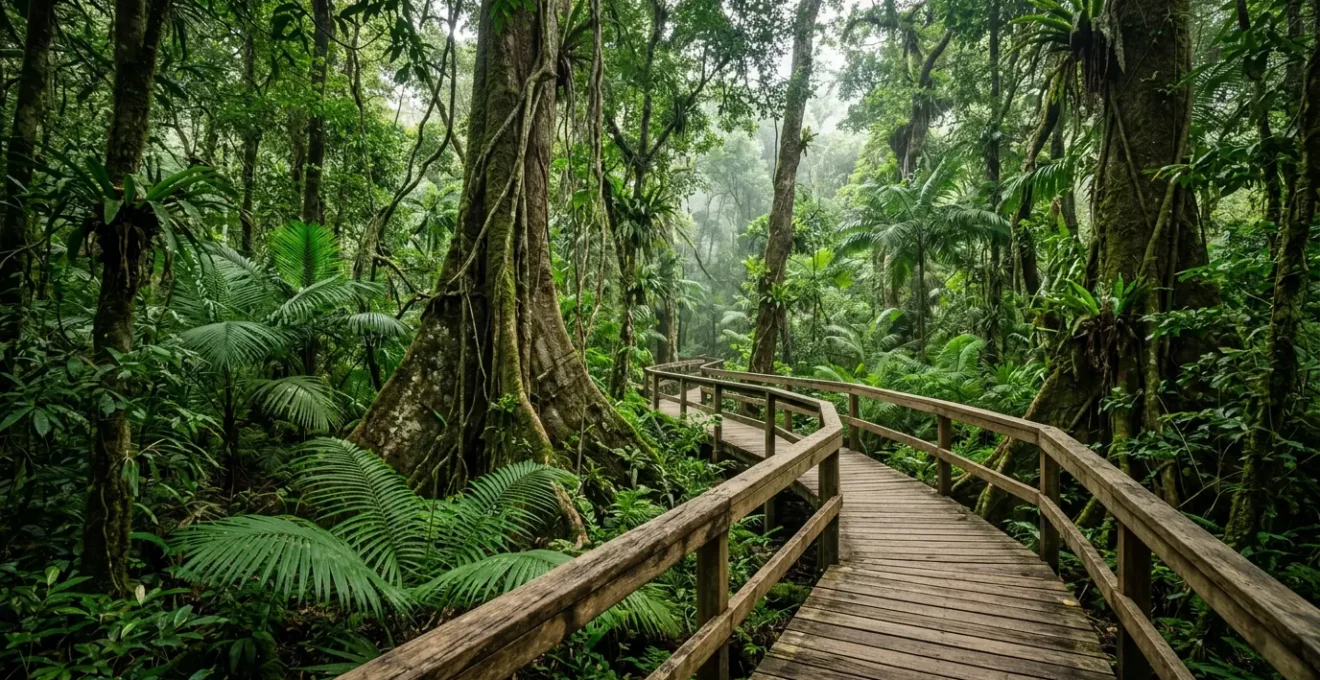
Walking the Daintree safely without a guide is entirely possible, but it requires shifting from fear-based avoidance to confident, system-based awareness.
- Master the « 5-metre rule » for all water bodies to mitigate crocodile risk and understand their behavioural patterns.
- Learn to identify the Gympie-Gympie stinging tree and know the correct, non-intuitive first-aid protocol involving wax strips.
Recommendation: Focus on understanding *why* these rules exist; this ecological intelligence is your best and most reliable guide.
The moment you step onto a Daintree Rainforest trail, you’re entering the world’s oldest surviving tropical rainforest. It’s a living museum, a cathedral of ancient fan palms, and winding mangrove systems where time seems to slow down. For nature enthusiasts, the call to explore this place on your own terms, away from a crowded tour, is powerful. But with that freedom comes a responsibility to understand the environment you’re in. Many guides will give you the standard advice: wear good shoes, carry water, and watch out for snakes. While true, this barely scratches the surface.
The real question for the independent explorer isn’t just about being wary of dangers, but about truly understanding them. You’ve likely heard the warnings about crocodiles and the infamous stinging trees. These are not exaggerated. However, navigating the Daintree isn’t about a constant state of fear. It’s about developing a new level of awareness—what we rangers call ‘ecological intelligence’. It’s the difference between knowing a rule and understanding the system behind it.
But what if the key to a safe and profound self-guided walk wasn’t a longer list of things to avoid, but a deeper understanding of the rainforest’s operating manual? This guide is built on that very principle. It moves beyond generic warnings to provide you with the same systematic protocols and situational awareness that we use. We’ll equip you with the knowledge to not just see the Daintree, but to read it. By understanding the ‘why’ behind the ‘what’, you can transform caution into confidence and have an experience that is both safe and deeply authentic.
This article breaks down the most critical aspects of a self-guided Daintree expedition. From plant identification and wildlife safety to logistical planning, you’ll find the practical, system-based advice needed to explore with respect and confidence.
Summary: A Ranger’s Protocol for Safe Daintree Self-Guided Walks
- Why Touching the Gympie-Gympie Stinging Tree Is a Medical Emergency?
- Cape Tribulation: Where the Rainforest Meets the Reef Explained
- Crocodile Safety in the Daintree: How Far from the Water Edge Is Safe?
- Crossing the Daintree River: How to Manage the Ferry Queue in Peak Season?
- Eco-Lodge or Camping: Which Offers the Best Night-Time Wildlife Spotting?
- Bush Tucker Knowledge: How Do Custodians Identify Edible Plants?
- Where to Find Wild Platypus: The Patience Required for a Sighting
- Seeing Koalas in the Wild: Why You Should Avoid Zoos for Authenticity?
Why Touching the Gympie-Gympie Stinging Tree Is a Medical Emergency?
Of all the hazards in the Daintree, none is more infamous or misunderstood than the Gympie-Gympie stinging tree (Dendrocnide moroides). This isn’t your average nettle; contact is a genuine medical emergency. The plant’s broad, heart-shaped leaves and stems are covered in fine, silica-tipped hairs called trichomes. When touched, these hairs act like tiny hypodermic needles, injecting a potent neurotoxin. The pain is immediate, excruciating, and can last for weeks or even months. It is crucial to be able to identify it: look for a soft-looking shrub, often on the edges of trails or in clearings, with large, serrated, heart-shaped leaves.
The common instinct to rub the affected area is the worst possible response, as it breaks the hairs and embeds them deeper in the skin. The toxin is stable and remains potent, which is why pain, pruritus, and burning can persist for months, flaring up with temperature changes or contact with water. Understanding this mechanism is key to applying the correct first aid, which is entirely non-intuitive.

The only effective field treatment is to remove the hairs without breaking them. Do not use creams or liquids. The ranger-approved method requires specific tools and a steady hand. Below is the precise protocol to follow. Memorise it, or better yet, carry the necessary supplies (tweezers and wax strips) in your first-aid kit. It is not an overstatement to say this knowledge can prevent a life-altering injury.
- Do not touch or disturb the affected area to prevent breaking the silica-tipped hairs.
- Remove visible larger hairs manually using tweezers.
- Apply hair removal wax strips directly to the affected skin. Do not spread liquid wax, as this will break the hairs.
- Press wax strips firmly and remove in one swift motion to extract the microscopic trichomes.
- Repeat with fresh wax strips until no more hairs are visible on the strip.
- Seek immediate medical attention if symptoms are severe, the sting covers a large area, or any signs of an allergic reaction appear.
This isn’t about creating fear, but about fostering deep respect for the rainforest’s powerful defence mechanisms. Knowing this protocol transforms a potential disaster into a manageable incident.
Cape Tribulation: Where the Rainforest Meets the Reef Explained
Cape Tribulation, or ‘Cape Trib’ as it’s known locally, holds a unique global status. It’s the only place on Earth where two UNESCO World Heritage sites sit side-by-side. As confirmed by Tourism Tropical North Queensland, this is where the ancient Wet Tropics Rainforest fringes the Great Barrier Reef. This extraordinary convergence creates a landscape of unparalleled beauty, but also a unique set of safety considerations that require a systematic approach.
The primary system to understand here is the tide. The magical experience of walking out onto the exposed reef flats from the beach is only possible, and safe, during low tide. At high tide, the water comes right up to the treeline, and the reef is submerged. Walking the beaches at low tide allows you to see exposed corals, colourful clams, and intricate marine life in the rock pools. However, this is not an invitation to swim. The Daintree coast is prime saltwater crocodile habitat, and the stinger season (typically October to May) brings dangerous Irukandji and Box Jellyfish close to shore.
A safe visit to this special place is dictated by a protocol of timing and spatial awareness. You must plan your activities around the tide chart and adhere to strict rules about your proximity to the water. A full-body stinger suit is non-negotiable if you choose to enter the water at a designated safe swimming hole, but beach swimming is strongly advised against year-round. Adhering to this system allows you to experience the magic of the ‘reef-meets-rainforest’ interface without becoming a statistic.
- Check tide timetables before you go; plan beach walks for low tide windows only.
- Always stay at least 5 metres from the water’s edge and avoid mangrove-lined estuaries.
- Wear a stinger suit during jellyfish season, even when just wading.
- Never swim unless you are in an area explicitly marked as safe and monitored.
- Do not prepare food or clean fish near the water, as this attracts crocodiles.
By treating the tidal chart and stinger season calendar as your guides, you can unlock the full wonder of Cape Tribulation while respecting the powerful natural forces at play.
Crocodile Safety in the Daintree: How Far from the Water Edge Is Safe?
The Estuarine or Saltwater Crocodile is the apex predator of the Daintree. These are not docile creatures; they are powerful, patient, and territorial ambush hunters. The most common question we rangers get is, « How far from the water is safe? » The answer is not just a number, but a system of behaviour. The official minimum distance is clear: at least 5 metres from the water’s edge at all times, and any campsite must be over 50 metres away. But this is the absolute bare minimum. True safety comes from understanding how crocodiles think.
Crocodiles are creatures of habit—both their own and yours. They observe patterns. They will watch a potential prey item (an animal or a person) return to the same spot to drink or fish day after day. This is why predictable behaviour is so dangerous in crocodile country. They can launch their entire body length out of the water from a complete standstill in a fraction of a second. The 5-metre rule is designed to put you just outside that initial strike zone, but it assumes you are not being complacent.
To truly stay safe, you must adopt the « Croc-Wise » mindset, which involves treating all waterways with extreme caution and thinking in terms of risk zones. It means never becoming a predictable target and remaining vigilant even when you feel safe. This is the system that keeps locals and rangers safe, and it’s the one you must adopt for your own exploration.
Your Croc-Wise Behavioural Audit
- Risk Zones: Mentally map every waterway into Red (0-5m, never enter), Amber (5-25m, high alert), and Green (50m+, safer) zones. Always know which zone you are in.
- Predictable Patterns: Inventory your planned activities. Will you be returning to the same spot to take photos, fish, or launch a kayak? If so, you must vary your location and timing.
- Food & Scraps: Be rigorous about your camp kitchen. Never prepare food, wash dishes, or dispose of food scraps (including fish guts) near the water’s edge. This is a direct attractant.
- Solitary Behaviour: Are you planning to walk or fish alone by the water? Crocodiles are known to target solitary individuals. Staying in a group increases vigilance and acts as a deterrent.
- Complacency Check: After a few days, it’s easy to relax. Actively check your behaviour. Are you still respecting the 5-metre rule? Have you started leaving gear near the bank? Stay alert for your entire trip.
Remember, in the Daintree, every river, creek, and even large puddle could be a crocodile’s home. Respect their territory by making yourself an uninteresting and unpredictable visitor.
Crossing the Daintree River: How to Manage the Ferry Queue in Peak Season?
Before you can explore the heart of the Daintree north of the river, you must first cross it. The Daintree River Ferry is the only way for vehicles to get to Cape Tribulation, and managing this crossing is a key logistical part of your trip. During peak season (school holidays, long weekends), the queue for this cable ferry can become a significant bottleneck. It’s not uncommon for waits to extend up to two hours during the busiest times.
The main traffic flow is predictable. Tour buses and day-trippers from Port Douglas and Cairns tend to head northbound between 10:00 am and 12:30 pm. The reverse happens in the afternoon, with a southbound rush between 3:00 pm and 5:00 pm as everyone heads back. Understanding this tidal flow of traffic is the first step to outsmarting the queue. Your goal as an independent traveller is to move against this main current. An early start is your best weapon.
Furthermore, there are several local tricks to make the crossing smoother. Pre-purchasing your ticket online is essential, as mobile reception can be patchy at the ferry itself. Have the QR code saved to your phone. Be aware that the right-hand lane is reserved for local residents with a priority pass; all visitors must use the left-hand lane. If you do find yourself in a queue on the south side, don’t just sit and wait. The small, quiet Daintree Village is a short drive away and offers a chance to grab a coffee or see the river from a different perspective, breaking up the wait time.
- Go Early or Late: Cross northbound before 9:30 am or return southbound after 5:30 pm to miss the tour bus rush hour.
- Pre-Purchase Tickets: Buy your ferry pass online before you leave your accommodation and save the QR code for offline access.
- Use the Correct Lane: Visitors must always use the left-hand lane when queuing for the ferry.
- Monitor Conditions: Check local Daintree and Cape Tribulation community Facebook groups for real-time updates on queue lengths.
- Plan for the Wait: If you must travel at peak time, have a plan to explore the south-side lookouts or Daintree Village instead of idling in the car.
By treating the ferry crossing as a strategic part of your journey rather than an obstacle, you can save valuable time and start your rainforest adventure on the right foot.
Eco-Lodge or Camping: Which Offers the Best Night-Time Wildlife Spotting?
When the sun sets, the Daintree transforms. The day’s heat gives way to a chorus of frogs and insects, and a completely different cast of characters emerges. For the nature enthusiast, the night is when the rainforest truly comes alive. A key decision that will shape your nocturnal experience is your choice of accommodation: a comfortable eco-lodge or an immersive campsite. Neither is definitively « better, » but they offer fundamentally different systems for wildlife observation.
An eco-lodge provides comfort, safety, and often, curated experiences. Many have elevated boardwalks and balconies that place you in the mid-canopy, offering a great vantage point for arboreal animals like sugar gliders and possums. Some lodges also run guided night walks, providing expert commentary and high-powered torches. However, the ambient light from the lodge, while minimal, can deter the most reclusive, light-sensitive species. The sounds of the rainforest are also somewhat filtered by the structure you’re in.
Camping, on the other hand, offers a raw, unfiltered immersion. With only the fabric of your tent between you and the forest, you are part of the soundscape. The minimal light pollution (using only a red-light headlamp to preserve night vision) means you’re more likely to encounter shy ground-dwellers like bandicoots and the elusive musky rat-kangaroo. It requires more preparation—mosquito nets and a good headlamp are essential—but the auditory and sensory reward is unparalleled. The choice depends on your priority: comfort and guided viewing, or total immersion and the chance for more serendipitous encounters.
| Factor | Eco-Lodge | Camping |
|---|---|---|
| Light Pollution | Moderate ambient lighting deters light-sensitive species but aids navigation | Minimal artificial light (torch-only) attracts more reclusive nocturnal animals |
| Wildlife Attracted | Sugar gliders, possums at baited/lit feeding areas; canopy species visible from balconies | Ground-dwelling species (bandicoots, musky rat-kangaroos), tree-kangaroos in mid-canopy |
| Auditory Experience | Filtered by building structures; less immersive soundscape | Unfiltered frog calls, fruit bat colonies, owl species, insect chorus – full immersion |
| Viewing Equipment | Binoculars for elevated canopy viewing from fixed platforms | Red-light headlamps (preserves night vision), ground-level scanning from tent proximity |
| Safety & Comfort | Guided night walks often included; screened protection from insects | Self-guided exploration; need mosquito nets and proper preparation |
Ultimately, whether you choose the canopy-level comfort of a lodge or the ground-level immersion of a tent, the Daintree at night is an experience that should not be missed.
Bush Tucker Knowledge: How Do Custodians Identify Edible Plants?
Walking through the Daintree, it’s easy to see the forest as a wall of green. But to the Traditional Custodians, the Kuku Yalanji people, this is a living pantry, pharmacy, and library. Their knowledge of « bush tucker » goes far beyond simply knowing which berry is safe to eat. It is a complex system of ecological intelligence, honed over millennia, that involves understanding seasons, processing techniques, and the interconnectedness of species. This is a level of understanding that a visitor can only begin to appreciate.
For the Kuku Yalanji, identifying an edible plant is often just the first step in a long process. Many of the most nutritious food sources in the rainforest are highly toxic in their raw state. The knowledge lies not just in identification, but in the sophisticated methods of preparation required to render them safe and nutritious. This process is a form of science passed down through generations. A perfect example of this is the Black Bean (Castanospermum australe).
Case Study: The Black Bean Transformation
The Black Bean demonstrates Indigenous ecological genius. While its seeds are highly toxic when raw, Kuku Yalanji custodians developed a multi-step process to transform them into a vital food source. This involved harvesting at specific times, leaching the sliced seeds in running water for an extended period to remove toxins, and then roasting them using precise techniques. This knowledge requires understanding everything from water flow rates to heat application—a complex system perfected over thousands of years. The plant’s presence also acts as an indicator, signaling soil and water conditions that predict the location of other important resources.
This deep knowledge is why self-guided foraging is exceptionally dangerous and disrespectful for visitors. Without this inherited, systematic understanding, a visitor cannot distinguish between a food source and a deadly poison. The safest and most respectful way to learn about bush tucker is through a guided tour with a Kuku Yalanji guide. They can share their knowledge and stories, offering a window into this incredible world of ecological wisdom.
Appreciating this sophisticated system fosters a deeper respect for the rainforest and its people, reminding us that we are merely guests in a place that has been understood and managed for tens of thousands of years.
Key Takeaways
- Safety in the Daintree is about understanding ecological systems—like crocodile behaviour and plant defences—not just avoiding generic dangers.
- Always apply strict, non-negotiable protocols for crocodiles (the 5m/50m rule) and Gympie-Gympie stings (mechanical removal with wax strips, not rubbing).
- Authentic wildlife encounters, like spotting a Tree-Kangaroo or platypus, are rewards for patience, specific techniques, and correct timing—not just luck.
Where to Find Wild Platypus: The Patience Required for a Sighting
Spotting a platypus in the wild is a true holy grail experience for any wildlife enthusiast. These shy, semi-aquatic monotremes are notoriously elusive, and the Daintree is one of the precious few places you might have a chance. However, a sighting is almost never a matter of luck. It is the reward for a systematic approach combining habitat knowledge, precise timing, and, above all, immense patience.
Platypus are creatures of habit and are extremely sensitive to noise and movement. You won’t find them in the brackish, crocodile-patrolled lower reaches of the Daintree River. Instead, you must head to the clear, cool, freshwater creeks that flow out of the rainforest highlands. Look for sections with still, deep pools, which they use for feeding, and undercut earthy banks where they dig their burrows. The presence of these features, combined with an abundance of their food source (aquatic insects), is a strong indicator of a platypus territory.
Timing is everything. Your best chances are at the edges of the day—dawn (roughly 5:30 am to 7:30 am) and dusk (5:30 pm to 7:00 pm). The protocol for observation requires you to become part of the landscape. Find a comfortable spot on an elevated bank, at least 10 metres from the water, and commit to being absolutely still and silent for a minimum of 45 minutes. Scan the water’s surface not for the animal itself, but for the tell-tale concentric rings of ripples that appear when it surfaces for a breath. This patient, methodical process is the only reliable way to earn a glimpse of this extraordinary animal.
- Habitat Cues: Focus on clear, upstream creeks with still, deep pools and earthy banks.
- Prime Timing: Be in position at dawn or dusk for the highest probability.
- Silent Observation: Sit motionless and in silence at least 10 metres from the water.
- Scan for Ripples: Look for the distinctive concentric circles on the water’s surface.
- Commit the Time: Plan for a minimum of 45-60 minutes of patient waiting.
- No Flash Photography: If you are lucky, use a long lens and absolutely no flash; they are extremely light-sensitive.
A platypus sighting is a privilege earned through respect and patience, embodying the very essence of what makes wildlife encounters in the Daintree so special.
Seeing Koalas in the Wild: Why You Should Avoid Zoos for Authenticity?
A common dream for visitors to Australia is to see a koala in the wild. However, it’s crucial to set the right expectations for the Daintree. Koalas feed almost exclusively on specific eucalyptus species that do not grow in this wet tropical environment. You will not find wild koalas in the Daintree Rainforest. Any promotion suggesting otherwise is misleading. The authentic arboreal mammal to look for here is a far more ancient and unique creature: the Bennett’s Tree-Kangaroo (Dendrolagus bennettianus).
Seeking out a Tree-Kangaroo offers a much more authentic and rewarding experience than visiting a zoo. In captivity, animals are often in artificial enclosures, their behaviours altered by routine and human interaction. A wild sighting, however brief, is a moment of genuine connection with an animal in its natural state, a testament to your patience and observation skills. According to visitor data from AllTrails on Daintree National Park, elevated boardwalks provide the best opportunities for spotting these elusive animals, particularly in the early morning.
Like the platypus, spotting a Tree-Kangaroo requires a specific search protocol. These animals spend their lives in the mid-to-high canopy, often camouflaged against tree trunks. The key is to look for their most distinctive feature: a long, thick tail hanging straight down from a branch. They are most active in the cool of the early morning and late afternoon. Elevated boardwalks, like the Jindalba Boardwalk, are ideal as they place you at their eye level, increasing your chances. Using binoculars is essential to scan the canopy methodically.
- Target Species: Focus your search on the Bennett’s Tree-Kangaroo, not koalas.
- Prime Locations: Use elevated platforms like the Jindalba Boardwalk to scan the mid-canopy (4-15 metres high).
- Look for the Tail: The most common first sighting is their long, rope-like tail hanging down from a branch.
- Scan Food Trees: Pay close attention to their favourite food trees, like the Umbrella Tree (Schefflera actinophylla).
- Be Patient: Spend at least 20 minutes slowly scanning each section of the boardwalk, looking for movement or the tell-tale tail.
- Binoculars are a Must: A good pair of 8×42 or 10×42 binoculars is crucial for spotting their camouflaged fur.
Now that you’re equipped with these ranger-approved safety systems and observation protocols, the next step is to plan your own confident, respectful adventure into the heart of the Daintree.