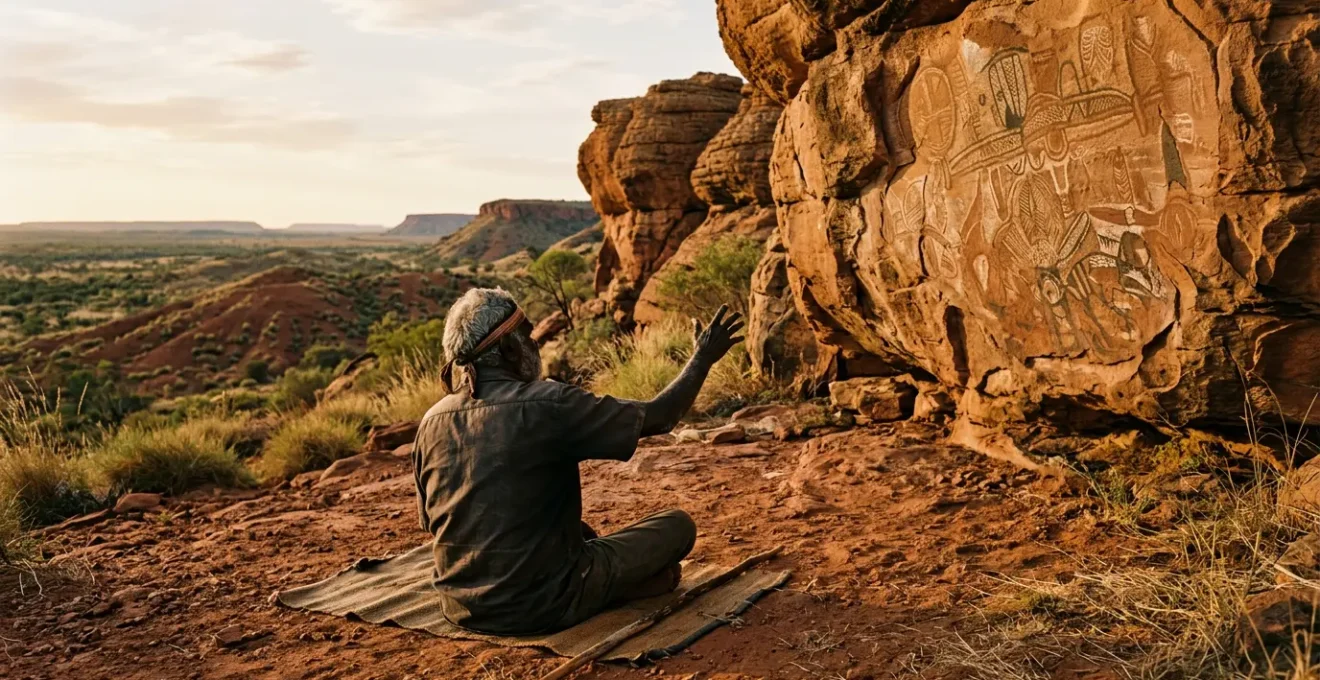
Aboriginal gendered knowledge is not about exclusion, but a sophisticated system designed to protect vital cultural information across millennia.
- Gender acts as a ‘cognitive firewall’, assigning different custodianship roles to men and women to ensure the integrity of sacred knowledge.
- Many stories are tied to specific locations (‘Country’) and can only be shared there, as the land itself is an essential part of the narrative.
Recommendation: Instead of viewing restrictions as a barrier, see them as an invitation to engage respectfully with one of the world’s oldest and most resilient knowledge-keeping traditions.
For a visitor to Australia, the encounter with Aboriginal mythology is profound. You hear of the Dreamtime, a complex spiritual reality that shapes all life, and you’re captivated. Yet, this fascination is often met with a point of confusion: the concepts of « men’s business » and « women’s business. » You might be told a story cannot be shared, a site cannot be photographed, or a ceremony is for one gender only. It’s easy to misinterpret these boundaries as arbitrary exclusion or secrecy for its own sake. The common advice is simply to « be respectful, » but what does that truly mean without understanding the underlying purpose?
The reality is far more intricate and brilliant than simple gatekeeping. These restrictions are not designed to keep you out; they are designed to keep critically important information intact. Think of it not as a locked door, but as a highly advanced knowledge management system, honed over tens of thousands of years. The separation of stories is not a social quirk but a core feature of its enduring success. This system uses landscape, ceremony, and social structure—including gender—as living archives.
So, what if the key to understanding isn’t asking *what* is secret, but *why* this system of custodianship is so fundamental? This article will unpack the cultural logic behind gendered knowledge. We will explore how stories function as maps, why physical presence on ‘Country’ is non-negotiable, and how oral tradition acts as a more powerful vessel for knowledge than any book. By understanding this framework, you’ll see that these protocols are not a rejection, but an invitation to witness a living, breathing culture on its own terms.
This guide breaks down the core principles of Aboriginal knowledge systems to help you navigate your journey with deeper understanding and respect. The following sections explore everything from the function of songlines to the practical ethics of choosing a children’s book.
Summary: Understanding Sacred Knowledge in Aboriginal Australia
- Songlines Explained: How Do Stories Function as Maps?
- Why Must You Be on Country to Hear Certain Stories?
- Secret/Sacred Knowledge: Why Can’t You Read Everything in Books?
- Children’s Books: Which Dreamtime Stories Are Public and Appropriate?
- Walking Tours with Elders: Why Is Oral Storytelling Better Than a Plaque?
- Welcome to Country vs Acknowledgement of Country: Who Can Say Which?
- No Photography Signs: Why Are Certain Angles of Uluru Censored?
- Kakadu Rock Art: Which Gallery Is Accessible for Seniors?
Songlines Explained: How Do Stories Function as Maps?
At the heart of Aboriginal epistemology is the concept of the Songline. These are not just myths or legends; they are complex, multipurpose tools for survival and cultural continuity. A Songline is an ancestral path across the land, sea, and sky, created by creator beings during the Dreamtime. As these beings travelled, they engaged in adventures and struggles, and their actions shaped the landscape—a hill, a river bend, a rocky outcrop. The story of their journey, sung as a song, becomes a verbal map that describes the physical, spiritual, and ecological reality of that path.
By singing the song in the correct sequence, a person can navigate vast distances, sometimes across the entire continent. The lyrics contain critical information about landmarks, water sources, the location of medicinal plants, and potential hazards. It’s a system of mnemonic devices, where the melody and rhythm help lock in thousands of data points. For example, a change in tempo might signify a change in terrain. This makes the stories an incredibly robust form of cartography. As Senior Indigenous curator Margo Ngawa Neale explains, « Songlines can be visualised as corridors or pathways of knowledge that crisscross the entire continent, sky and water. »
The scale of these cognitive maps is staggering; one documented songline stretches an astonishing 3,500 kilometers, tracing a trade route from the northern coasts deep into the desert. This demonstrates that a story is never just a story. It is a map, a survival guide, a legal charter, and a spiritual scripture all woven into one. Understanding this is the first step to appreciating why the integrity of these narratives is so fiercely protected.
Why Must You Be on Country to Hear Certain Stories?
A common question from visitors is why certain stories cannot be told away from their specific location. This isn’t an arbitrary rule; it’s because the land—or ‘Country’ in Aboriginal English—is not a passive backdrop for the story. It is an active participant, a co-narrator. The physical features of the landscape are the mnemonic triggers for the story itself. A particular rock formation isn’t just *described* in the story; it *is* the story, embodied in stone. To tell the tale without the physical presence of that landmark would be like trying to read a book with half the pages torn out.
These places are what the National Museum of Australia describes as living libraries. « These sites of significance, formed by ancestral beings, are like libraries, storing critical knowledge for survival. » Each crevice, waterhole, and ochre deposit is a chapter, holding information about law, ecology, or ceremony. Being ‘on Country’ allows the storyteller, a designated knowledge custodian, to point to these features, activating the story in the mind of the listener. The knowledge is ‘sung’ into the landscape and can only be fully retrieved in its presence. The land holds the memory.

This is why a simple recording or written summary can never capture the essence of the experience. The transmission of knowledge is multi-sensory: it involves seeing the land, feeling the wind, smelling the plants, and hearing the story in its intended context. Removing the story from Country strips it of its power, its accuracy, and its sacredness. It becomes an empty shell, which is why custodians will only share certain narratives when you are standing in the very place where they came to be.
Secret/Sacred Knowledge: Why Can’t You Read Everything in Books?
The idea that some knowledge is secret or sacred is central to understanding Aboriginal culture, and it’s here that the roles of men and women become paramount. In Western traditions, knowledge is often democratised; the goal is to make information universally accessible through books and the internet. In contrast, Aboriginal oral traditions operate on a system of tiered access. This system is not about hiding information, but about protecting it and ensuring its responsible use. As cultural memory expert Lynne Kelly notes, « In oral cultures, knowledge is power. It is imperative that the most important knowledge be maintained and preserved by a few select custodians who have proven their worth. »
This knowledge is layered, with public stories available to all, while deeper levels are reserved for those who have undergone the necessary training, ceremonies, and have proven themselves responsible. This system has been incredibly effective; research published in 2023 confirms some oral traditions have been transmitted accurately for over 12,000 years. Gender is a fundamental part of this protective structure. « Men’s business » and « women’s business » refer to distinct but complementary sets of knowledge, responsibilities, and ceremonies. Men are the custodians for certain stories and laws, while women are the custodians for others. This division acts as a cognitive firewall. By separating the knowledge domains, the culture ensures that no single person or group holds all the information, creating a system of checks and balances that enhances the resilience and data integrity of the entire cultural archive.
This is why some stories are restricted. It’s not an act of sexism or exclusion, but a time-tested protocol for preserving high-stakes information—from complex ecological knowledge to sacred laws—that is essential for the community’s spiritual and physical survival. Exposing this knowledge to the uninitiated or in the wrong context would be a profound violation of Aboriginal Law, equivalent to declassifying state secrets or desecrating a holy scripture.
Children’s Books: Which Dreamtime Stories Are Public and Appropriate?
While deep ceremonial knowledge is restricted, many Aboriginal stories are public and meant to be shared widely, especially with children. These narratives are a vital tool for education, teaching morality, explaining the natural world, and fostering a connection to culture from a young age. For visitors, engaging with these stories through children’s literature is one of the most accessible and respectful ways to learn. However, it is crucial to do so ethically.
The publishing world has, at times, exploited Aboriginal stories without proper consent or compensation. To avoid perpetuating this, you must choose books that are created with and for the community they represent. It’s about ensuring that the benefits flow back to the knowledge custodians and that the stories are told with authenticity and respect for their origins. Before purchasing a book, it’s worth taking a moment to check for a few key indicators of ethical practice.
Ethical Checklist for Choosing Aboriginal Children’s Books
- Verify a Traditional Custodian from the specific nation is credited as author or consultant.
- Confirm royalties are returned to the Indigenous creator and/or their community.
- Check that the book acknowledges the specific language group, not just ‘Aboriginal’ generically.
- Prioritize books from Indigenous-led publishers like Magabala Books (Aboriginal owned and operated).
- Ensure the publisher protects cultural and intellectual property rights of Indigenous creators.
Magabala Books: Indigenous-Led Publishing Model
Magabala Books, operating from Broome in Western Australia, exemplifies ethical Indigenous publishing. As Australia’s leading Indigenous publishing house, they are Aboriginal owned and led, passionate about protecting cultural and intellectual property rights. Their model, as highlighted in guides on authentic Indigenous literature, ensures Indigenous peoples hold copyright in their stories with benefits returned directly to creators and their communities, demonstrating how the publishing industry can support rather than exploit Aboriginal storytelling traditions.
By making conscious choices, you not only get to enjoy a beautiful story but also become a part of a respectful exchange, supporting the artists and communities who are the rightful owners of these ancient narratives.
Walking Tours with Elders: Why Is Oral Storytelling Better Than a Plaque?
In many tourist locations, information is delivered passively through signs and plaques. While useful, this static format is fundamentally at odds with the living nature of Aboriginal knowledge. This is why participating in a walking tour led by an Elder or a traditional custodian is an infinitely richer experience. Oral storytelling is a dynamic, interactive, and responsive medium that a written plaque can never replicate.
When an Elder shares a story on Country, they are not merely reciting a memorised script. They are actively reading the landscape and responding to the environment and the audience in front of them. They might point out a plant that has just come into fruit, explain its use, and link it to a specific part of the Dreamtime narrative. They can answer your questions, tailoring the depth of information to your level of understanding. This creates a two-way dialogue, a genuine moment of cultural transmission rather than a one-way broadcast of facts. The story comes alive because it is being performed by a living custodian, not just written down.
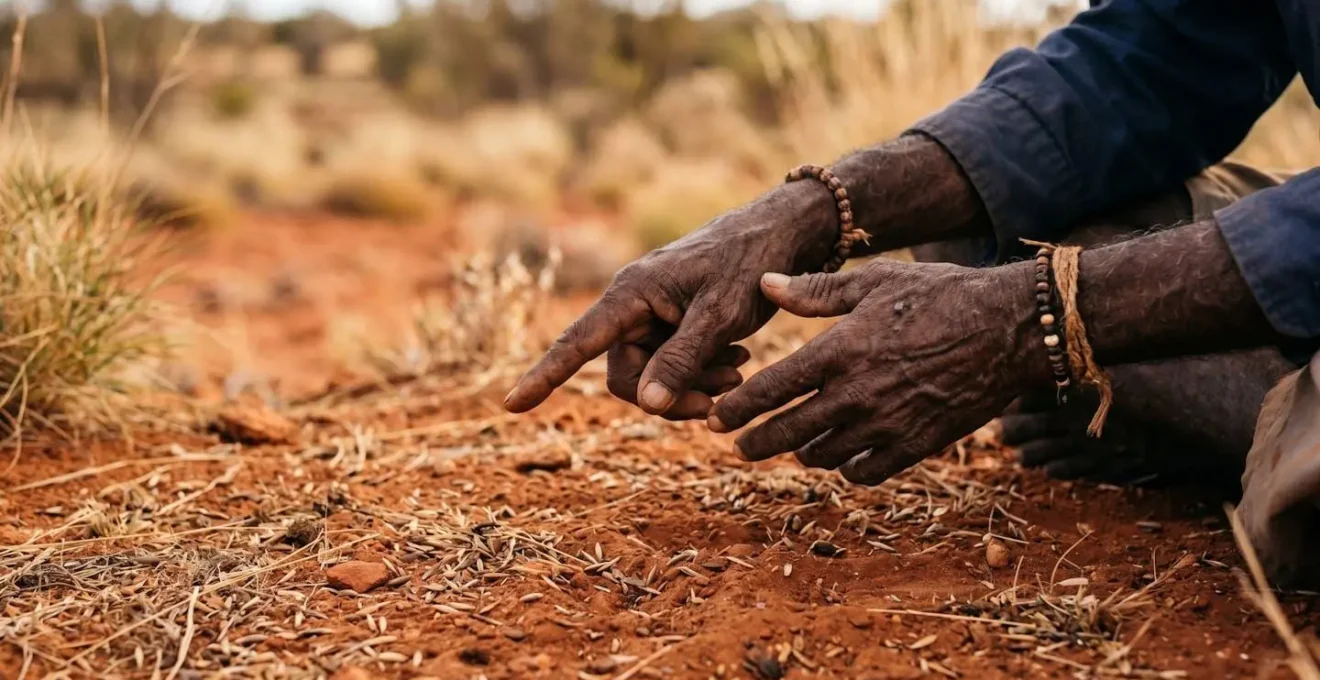
Furthermore, the gestures, the tone of voice, and the pauses are all integral parts of the story’s meaning. These nuances are lost in written text. A plaque can tell you a rock is a sacred site, but an Elder can convey the feeling of reverence and responsibility associated with it, sharing the story with the weight and wisdom of generations of custodianship behind them. Choosing a tour with a traditional custodian is a direct investment in the continuity of this oral tradition, ensuring that the knowledge holders are supported to continue their vital work of keeping culture strong and alive.
Welcome to Country vs Acknowledgement of Country: Who Can Say Which?
As you travel through Australia, you will frequently encounter two important cultural protocols: a Welcome to Country and an Acknowledgement of Country. For many visitors, the distinction can be unclear, yet it is fundamental to understanding authority and respect in an Aboriginal context. Knowing the difference is a crucial part of demonstrating cultural competence and appreciating the deep-rooted protocols of the land you are visiting.
A Welcome to Country is a ceremony performed by an Aboriginal or Torres Strait Islander person to welcome visitors to their traditional land. It is an ancient practice, rooted in the necessity of seeking permission before entering another group’s territory. As Reconciliation Australia explains, « Protocols for welcoming visitors to Country have always been a part of Aboriginal and Torres Strait Islander cultures. Boundaries were clear, and crossing into another group’s Country required a request for permission to enter. » Only a Traditional Owner of that specific Country, or someone with their explicit permission, has the authority to perform a Welcome. It is an act, not just words, and can include song, dance, or a smoking ceremony, granting visitors safe passage.
An Acknowledgement of Country, by contrast, is a statement of respect that can be made by anyone, Indigenous or non-Indigenous. It is a way of showing awareness and paying respect to the Traditional Owners of the land where an event is taking place. While a Welcome holds cultural authority, an Acknowledgement is an expression of respect. The following table, based on guidelines from authoritative bodies like Reconciliation Australia, clarifies the key differences.
| Aspect | Welcome to Country | Acknowledgement of Country |
|---|---|---|
| Who Can Perform | Only Traditional Owners or Aboriginal/Torres Strait Islander peoples with permission from Traditional Owners | Any person (Indigenous or non-Indigenous) |
| Nature | A ceremonial act – grants visitors safe passage and spiritual protection | A respectful statement – recognizes Traditional Owners’ authority |
| Authority | Requires traditional jurisdiction over that specific Country | Requires no special authority, but should be sincere and informed |
| Format | Can include singing, dancing, smoking ceremonies, speech in language or English | Typically a spoken or written statement at event opening |
| Cultural Significance | Active participation in ancestral protocols thousands of years old | Contemporary protocol of respect and awareness |
Key Takeaways
- Gendered knowledge (‘men’s/women’s business’) is a sophisticated system for protecting vital information, not arbitrary exclusion.
- Stories (Songlines) are complex maps and survival guides intrinsically linked to the physical landscape (‘Country’).
- Respectful engagement means supporting ethical sources like Indigenous-led publishers and tour operators, and observing protocols like photography bans.
No Photography Signs: Why Are Certain Angles of Uluru Censored?
Few sites are as iconic as Uluru, and the natural impulse for many visitors is to photograph it from every angle. So, it can be jarring to encounter signs that prohibit photography of certain sections of the rock. This is not about managing tourist crowds or protecting a commercial interest. It is a direct and necessary enforcement of Aboriginal Law related to the protection of sacred, restricted knowledge. For the traditional custodians, the Aṉangu people, Uluru is not a monolithic object but a complex and sacred text.
As memory expert Lynne Kelly states, based on her work on Aboriginal knowledge systems, « At Uluru, the Anangu elders associate every crevice, bump, and notch around the perimeter of the mountain with knowledge that is stored to memory. » Certain features are directly associated with restricted ceremonies and stories—some being men’s business, others women’s business. To photograph these features would be to capture and potentially broadcast parts of a sacred text to the uninitiated. It is the visual equivalent of publishing a secret ceremonial script. The ‘no photography’ signs are a modern tool used to uphold an ancient law.
Kata Tjuta: Gendered Sacred Sites and Photography Restrictions
The nearby site of Kata Tjuta (the Olgas) offers a clear example of this principle. The stunning domes were created by ancestral beings, and the site contains distinct sacred areas designated as men’s sites and women’s sites. Photographing specific features of these formations would expose initiatory knowledge to the public, fundamentally violating Aboriginal Law. The photography ban is not an arbitrary rule for tourists; it is a critical assertion of Aṉangu custodianship and a direct test of a visitor’s willingness to respect cultural protocols, even if they don’t fully understand the deep meaning behind them.
By respecting these signs, you are not just following a rule; you are actively participating in the protection of this cultural library. You are demonstrating that you understand that the right of the Aṉangu to maintain their cognitive firewall and protect their cultural integrity is more important than your desire for a photograph. It is an act of profound respect.
Kakadu Rock Art: Which Gallery Is Accessible for Seniors?
Kakadu National Park is home to one of the world’s greatest concentrations of rock art. This art is not decorative; it is a library of stories, laws, and historical records, with some Aboriginal rock art in Australia dating back over 40,000 years. For many visitors, especially seniors or those with limited mobility, the desire to witness this ancient heritage can be accompanied by concerns about accessibility. Fortunately, Kakadu’s custodians and Parks Australia have made significant efforts to ensure some of the most spectacular galleries can be appreciated by all.
Two of the most renowned and accessible sites are Ubirr and Burrungkuy (Nourlangie). While reaching the escarpment lookout at Ubirr requires a steep climb, the main art gallery at its base is easily accessible. A flat, 1-kilometer circular walking track takes you past incredible X-ray paintings of fish and turtles, as well as depictions of the Rainbow Serpent. This section is wheelchair-accessible and provides an immersive experience without strenuous effort.
At Burrungkuy (Nourlangie), the main Anbangbang gallery is similarly accessible. A 1.5-kilometer circular walk on a well-maintained path and boardwalk leads you to stunning shelters. Here, you can see famous figures like Namarrkon (Lightning Man) and Nabulwinjbulwinj, a dangerous spirit who eats females after striking them with a yam. The interpretation signs are excellent, and the path is mostly flat and shaded. These sites prove that accessibility and profound cultural immersion can go hand-in-hand, allowing visitors of all ages and abilities to bear witness to this incredible, living heritage. Always check the official Kakadu National Park access report before visiting, as conditions can change.
Understanding these cultural principles transforms your journey from simple sightseeing into a meaningful cultural exchange. By respecting the protocols around storytelling, you are not being excluded; you are being invited to honour one of humanity’s most enduring and sophisticated traditions of knowledge.