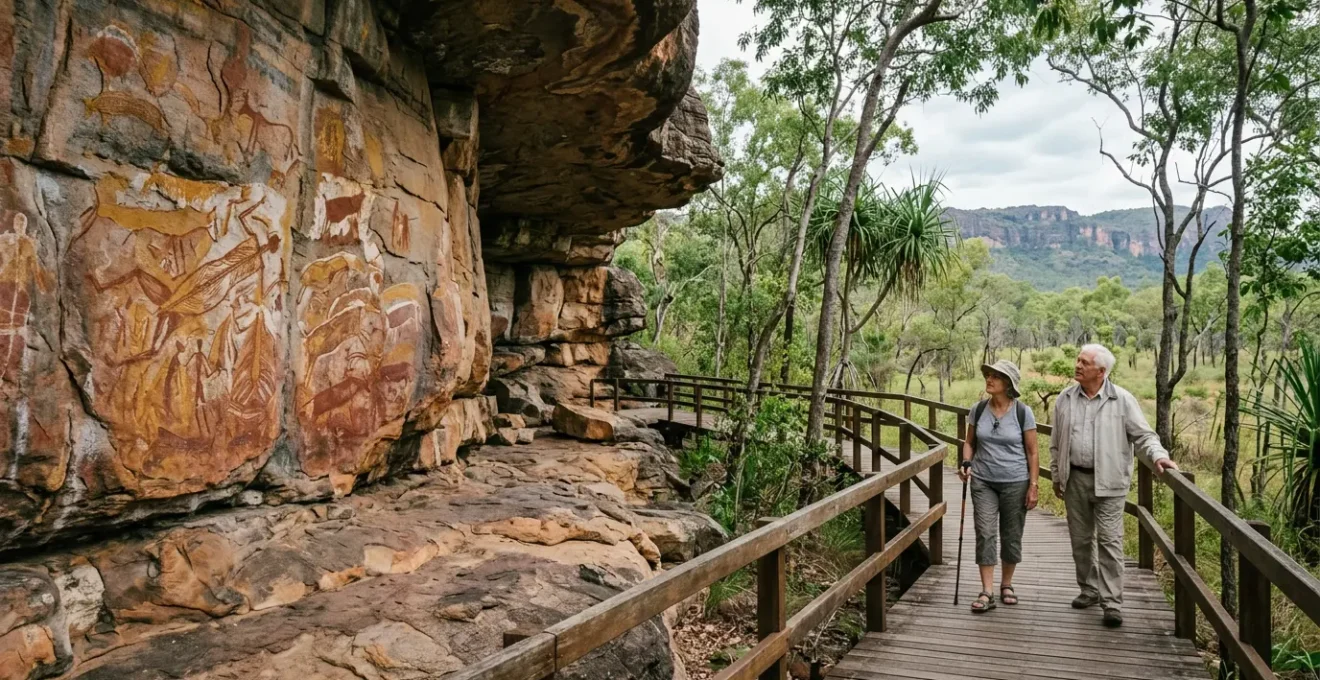
Experiencing Kakadu’s iconic rock art doesn’t have to mean tackling steep climbs or risking the intense heat.
- The most profound art at sites like Ubirr and Burrungkuy (Nourlangie) is on flat, wheelchair-accessible paths.
- Understanding the critical difference between heat exhaustion and heat stroke is non-negotiable for a safe visit.
- Smart planning, including checking wet season access and understanding the cultural context, unlocks a deeper experience.
Recommendation: Prioritise the main, ground-level galleries at Burrungkuy (Nourlangie) for a world-class, climb-free, and safer viewing experience.
The dream of visiting Kakadu National Park often conjures images of vibrant ochre paintings clinging to ancient rock faces, a testament to one of the world’s oldest living cultures. For senior travellers, however, this dream can be tinged with apprehension. Stories of steep climbs to sunset lookouts and warnings about the oppressive Northern Territory heat can make the entire endeavour seem daunting, if not impossible. Many travel guides focus on the athletic feat of reaching a summit, suggesting that the only reward is the view from the top.
But what if the real key to unlocking Kakadu’s secrets isn’t about physical endurance, but about strategic planning and intellectual access? What if the most compelling stories aren’t found at the highest point, but are waiting to be discovered on flat, accessible ground? This approach shifts the focus from conquering the landscape to connecting with it. It values understanding the art’s meaning, the science of its preservation, and the living culture that continues to care for it.
This guide is built on that principle. We will move beyond the generic advice to « wear a hat » and instead provide a framework for a safe, comfortable, and deeply enriching visit. We will explore the meaning behind the famous X-ray paintings, understand the real risks of the climate and how to mitigate them, and reveal how to access the most magnificent galleries without a single strenuous climb. This is about experiencing Kakadu smarter, not harder.
This article provides a comprehensive plan to help you navigate Kakadu’s rock art sites with confidence. The following sections break down everything from understanding the art itself to practical safety tips and cultural insights.
Summary: A Senior’s Guide to Kakadu’s Accessible Rock Art
- Reading Rock Art: What Do the X-Ray Skeletons Signify?
- Why Can’t You Touch the Rock Art: The Science of Sweat and Oils?
- Ubirr in the Wet Season: Is It Accessible When the Floodplains Rise?
- Overpainting Layers: Why Did Artists Paint Over Old Images?
- Park Passes: Where Does Your Kakadu Entry Fee Actually Go?
- Accessible Walk Alternatives: Seeing Kakadu’s Best Art Without the Climb
- Heat Stroke vs Heat Exhaustion: When Should You Call the Flying Doctor?
- Indigenous Rangers: How Do They Manage Bushfires Differently?
Reading Rock Art: What Do the X-Ray Skeletons Signify?
Viewing Kakadu’s rock art is like reading a library where the books are millennia old. The region is a vast gallery, with Kakadu National Park alone containing over 5,000 known Aboriginal rock art sites. Among the most iconic and fascinating styles is the « X-ray » art, which depicts not just the external form of animals and humans, but their internal skeletons and organs. This isn’t a stylistic quirk; it’s a profound statement of knowledge and a powerful teaching tool.
This intricate style demonstrates a deep anatomical understanding, passed down through generations. For the Bininj/Mungguy people, this art served multiple purposes. It was a way to teach younger generations about anatomy, which was crucial for hunting (knowing where to strike) and butchering. It also holds deep spiritual significance, connecting the physical world with the realm of creation ancestors. The paintings often show which parts of an animal are good to eat and how to prepare them, acting as a permanent, visual guide to country and its resources.
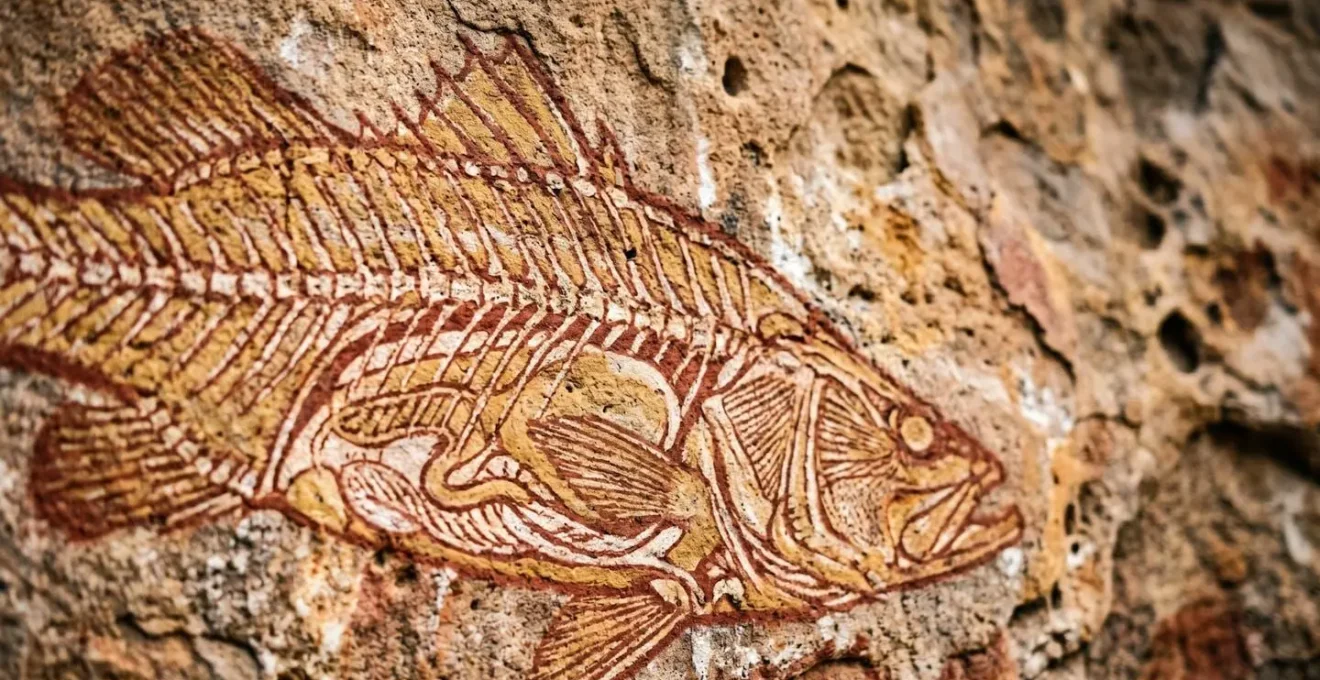
As the National Museum of Australia notes, this unique form of expression is a hallmark of the region’s art. When you look at an X-ray painting of a barramundi, you are seeing more than a fish; you are seeing a diagram of life, a lesson in survival, and a spiritual icon. This intellectual access to the meaning behind the art is the first step in a truly rewarding visit, transforming a simple viewing into a rich, educational experience that requires no climbing at all.
Why Can’t You Touch the Rock Art: The Science of Sweat and Oils?
The urge to connect with something ancient by touching it is understandable, but at rock art sites, it’s a destructive impulse. The « no touching » rule isn’t just about respecting regulations; it’s based on hard science. The delicate chemistry of these ancient paintings is incredibly vulnerable to the oils, salts, and acids present on human skin. Even the slightest touch can introduce contaminants that accelerate deterioration and erase thousands of years of history.
Our skin is naturally acidic, and the oils we secrete to keep it moisturised can bind dust and pollutants to the rock surface, obscuring the art. More damaging are the salts in our sweat. When these crystallise, they can physically lift the pigment from the rock. Scientific research has shown that even low pH values from contaminants can dissolve the rock’s protective patina, leaving the art underneath exposed and vulnerable to erosion. While this study focused on industrial emissions, the principle of acidic damage is the same.
Think of it like an ancient, fragile manuscript. A single greasy fingerprint can degrade the page over time. The same is true for the ochre and clay pigments used in Kakadu. These materials have survived for millennia precisely because they have been left undisturbed in sheltered overhangs. By keeping a respectful distance, every visitor becomes a custodian, ensuring that this irreplaceable cultural heritage can be experienced by generations to come. The best way to « connect » with the art is to understand it, not to touch it.
Ubirr in the Wet Season: Is It Accessible When the Floodplains Rise?
Ubirr, with its iconic sunset views and sprawling galleries, is a highlight of Kakadu. However, its location on the edge of the Nadab floodplain means access becomes a major challenge during the tropical summer, or « wet season. » From roughly December to April, monsoonal rains can cause the Magela Creek to flood, cutting off the road entirely. For senior travellers planning a trip during this period, assuming Ubirr is off-limits is a common mistake. The truth is, access is possible, but it requires strategic planning.
The key is to monitor conditions and know the alternatives. Road closures are not always permanent throughout the entire wet season; they can change daily based on water levels. During this time, the official Kakadu Access Report becomes an essential tool. Furthermore, some tour operators have special permits and are equipped to navigate the flooded crossings or even use boats to shuttle visitors to the site. This can turn a logistical challenge into a unique adventure, offering a chance to see the landscape in its most dramatic and verdant state.
Ultimately, a successful wet season visit is about flexibility. While the road to Ubirr can become inaccessible between December and April, having a solid backup plan is vital. Burrungkuy (Nourlangie), another world-class site, is generally accessible year-round and is less affected by flooding. Planning for both possibilities ensures that your trip won’t be derailed by the weather.
Your action plan: Checking Ubirr access during the wet season
- Check the official Kakadu Access Report online for daily updates on road conditions and site closures.
- Contact the Bowali Visitor Centre near Jabiru for the most up-to-date, real-time information that websites may not reflect.
- Consider booking a wet season tour that includes boat or high-clearance vehicle access to Ubirr when roads are impassable.
- Have a backup plan to visit alternative sites like Burrungkuy (Nourlangie), which remains open year-round and is less affected by flooding.
Overpainting Layers: Why Did Artists Paint Over Old Images?
At many Kakadu art sites, visitors will notice that paintings overlap, with newer, more vibrant figures painted directly on top of older, faded ones. This wasn’t an act of vandalism or a lack of space. This practice of overpainting, or re-marking, is a crucial part of the art’s living tradition and demonstrates the concept of cultural continuity. The rock face is not a static canvas but a dynamic, living storybook that is continually updated.
For Bininj/Mungguy, an art site’s power is not just in its original creation but in its ongoing use and maintenance. Repainting a motif could be done for several reasons: to revitalise the power of a sacred site before a ceremony, to teach a younger artist the story and technique associated with the figure, or to reaffirm a clan’s connection and responsibility to that specific place and its stories. Some sites are living archives, where archaeological studies in Western Australia have revealed more than 30 layers of pigment, documenting thousands of years of continuous cultural practice.
This tradition challenges the Western concept of a finished artwork that must be preserved untouched. Here, the act of creation and re-creation is part of the art’s purpose. As Kate Owen Gallery explains, this is a deeply meaningful and necessary cultural practice.
Re-marking these rock art sites is a culturally approved and, in some instances, necessary practice. Indigenous custodians may revitalize a motif before a ceremony or ritual, or to assert their connection with the natural and spiritual worlds.
– Kate Owen Gallery, Australian Aboriginal Rock Art Cultural Practice
Recognising these layers allows you to see the art not as a relic of a lost past, but as evidence of a resilient, living culture that continues to engage with its most sacred sites.
Park Passes: Where Does Your Kakadu Entry Fee Actually Go?
When you purchase your Kakadu National Park pass, it’s easy to see it as just another entry fee. However, in this unique World Heritage-listed park, that fee represents a direct investment in one of the world’s most successful conservation and cultural partnerships. Kakadu is jointly managed by the Bininj/Mungguy traditional owners and Parks Australia, a model that ensures Indigenous knowledge is at the heart of the park’s operations.
Your park pass fee is a crucial revenue stream that supports this joint management structure. A significant portion of the funds goes directly to the traditional owners as part of the lease agreement, as approximately half the land in Kakadu is Aboriginal land leased back to the government. This income provides economic self-determination and empowers communities to remain on their ancestral lands. The rest of the funds are channelled into the park’s operational budget, which covers everything from maintaining visitor infrastructure like boardwalks and viewing platforms to critical conservation work.
A prime example of this is the funding of the Indigenous Ranger program. As detailed in a project by The Conversation, park fees help support ranger teams, including the East Alligator daluk (female) rangers. These teams conduct annual rock art monitoring, using a blend of traditional knowledge and modern technology to protect the sites. The program also ensures the transfer of knowledge to younger generations, keeping the culture strong and the art visible and protected for visitors. Your pass isn’t just a ticket; it’s a contribution to the stewardship of this incredible place.
Accessible Walk Alternatives: Seeing Kakadu’s Best Art Without the Climb
Many travellers believe that the best views and most important art in Kakadu require a strenuous climb. The famous Ubirr lookout, for instance, involves a steep, 250-metre rock scramble that can be challenging for anyone, especially seniors with knee or mobility concerns. However, the reality is that 90% of Kakadu’s most significant and spectacular rock art is accessible via flat, easy, and often wheelchair-friendly paths. Focusing on ground-level immersion is the smartest way to experience the park.
The main art galleries at both Ubirr and Burrungkuy (Nourlangie) are located at the base of the rock escarpments. At Burrungkuy, the 1.5-kilometre circular walk through the main gallery is almost entirely flat and includes boardwalks. This path leads you to stunning shelters containing world-famous images like Namarrgon (Lightning Man) and the Anbangbang gallery. You can spend hours here, immersed in art and story, without climbing a single step.
Similarly, at Ubirr, while the lookout gets much of the attention, the main galleries on the 1-kilometre loop walk at its base are where the most detailed X-ray art is found. The path is flat and easily navigated. By choosing to focus on these main galleries, you are not settling for a lesser experience; you are making a strategic choice to see the highest concentration of world-class art in the most comfortable and safest way possible. The climb to the Ubirr lookout, while offering a beautiful panoramic view, is just that—a view. The art itself is at ground level.
Your checklist: Senior-friendly viewing options at Kakadu
- Prioritise Burrungkuy (Nourlangie) main gallery: The path is completely flat and wheelchair accessible, allowing you to see world-class art, including Namarrgon (Lightning Man), without any climbing.
- Explore Ubirr’s main art galleries (not the lookout): The area around the main art site is flat and provides access to famous X-ray paintings without the steep lookout climb.
- Use the lower galleries and shelters: Multiple lower viewing areas at both sites offer most of the visual impact without strenuous activity, ensuring you can experience authentic rock art safely.
- Visit the Warradjan Aboriginal Cultural Centre: This fully accessible centre provides deep context on culture and stories, enriching your on-site art viewing experience.
- Consider a Yellow Water Cruise: A boat cruise is a fantastic, seated way to experience the landscape’s majesty and wildlife, offering a different but equally rewarding perspective.
Heat Stroke vs Heat Exhaustion: When Should You Call the Flying Doctor?
In the extreme climate of Kakadu, understanding the difference between heat exhaustion and heat stroke is not just useful information; it is a critical piece of risk mitigation that can be life-saving. For senior travellers, whose bodies may be less able to regulate temperature and who might be on medications that affect hydration, this knowledge is non-negotiable. The two conditions sound similar but have vastly different symptoms and require completely different responses.
Heat exhaustion is the body’s warning sign that it’s getting overwhelmed by heat. Symptoms include heavy sweating, dizziness, nausea, and a faint or weak feeling. If you or a travel companion experience this, it’s an immediate signal to stop all activity, move to the shade, rest, and rehydrate with water or electrolyte drinks. Cooling the body with a damp cloth can also help. Symptoms should start to improve within about 20 minutes. It’s a serious condition, but it’s reversible with prompt action.
Heat stroke, on the other hand, is a medical emergency. It occurs when the body’s core temperature rises to a dangerous level (above 40°C or 104°F) and the internal cooling system fails. The most critical tell-tale sign is a change in mental state: confusion, agitation, or loss of consciousness. A person with heat stroke may have a rapid pulse and, crucially, may have stopped sweating despite the heat. This is an immediate EMERGENCY. Do not wait. Send someone to find a park ranger or use a satellite phone to call for help immediately. This condition can cause permanent organ damage or death if not treated urgently.
| Condition | Key Symptoms | Action Required | Timeframe |
|---|---|---|---|
| Heat Exhaustion | Heavy sweating, dizziness, nausea, headache, muscle cramps | Move to shade, rest, hydrate with water/electrolytes, cool with damp cloth | Should improve within 15-20 minutes |
| Heat Stroke (Emergency) | Confusion, no sweating despite heat, rapid pulse, loss of consciousness, body temp above 40°C (104°F) | CALL EMERGENCY – Send someone to find Ranger or use satellite phone immediately | Life-threatening – requires immediate medical evacuation |
| Senior-Specific Warning | Medications (diuretics, beta-blockers) can mask symptoms or accelerate progression | If symptoms don’t improve after 15-20 minutes of rest and hydration, treat as emergency | Seniors can progress from exhaustion to stroke more rapidly than younger adults |
Key takeaways
- The most profound rock art experiences in Kakadu are on flat, accessible ground-level paths, not at the top of strenuous climbs.
- Safety is paramount. Plan your walks for the cooler early mornings, carry ample water, and know the life-threatening difference between heat exhaustion and heat stroke.
- A deeper appreciation comes from understanding the context: the meaning of the art, the living culture that maintains it, and your role as a visitor in its preservation.
Indigenous Rangers: How Do They Manage Bushfires Differently?
Visitors to Kakadu during the dry season (roughly May to October) will likely see smoke on the horizon or drive past recently burned landscapes. This isn’t a sign of uncontrolled wildfire, but rather a sophisticated and ancient practice of land management. Indigenous rangers manage fire in a way that is fundamentally different from Western fire-fighting, viewing it not as a threat to be suppressed but as a tool to be used with precision and care.
The primary method is « cool » or « cultural » burning. These are intentionally lit, slow-moving fires set during the early dry season when vegetation still has some moisture. They burn with low intensity, clearing out the dense, flammable undergrowth of introduced grasses like gamba grass. This practice creates a mosaic of burnt and unburnt patches across the landscape. This « patchwork quilt » acts as a natural firebreak, preventing the build-up of fuel that could lead to devastating, high-intensity fires later in the hot, windy season.
This fire management is guided not by a four-season calendar, but by the Bininj/Mungguy six-season calendar, which is based on millennia of ecological observation. Rangers know it’s the right time to burn when specific plants are flowering or when certain animals change their behaviour. This deep ecological knowledge, or traditional stewardship, is now recognised globally as a highly effective method for reducing carbon emissions from wildfires, even generating income for communities through carbon credit programs. The smoke you see is often a sign of a healthy, well-managed country.
By approaching Kakadu with a strategy that prioritises safety, comfort, and understanding, you transform your visit. The richest experience isn’t about ticking off a viewpoint; it’s about connecting with 65,000 years of continuous culture. Plan your visit for the cooler hours, choose the flat, accessible paths, and take the time to truly see the stories on the rock. This is how you can confidently and safely experience the magic of Kakadu.