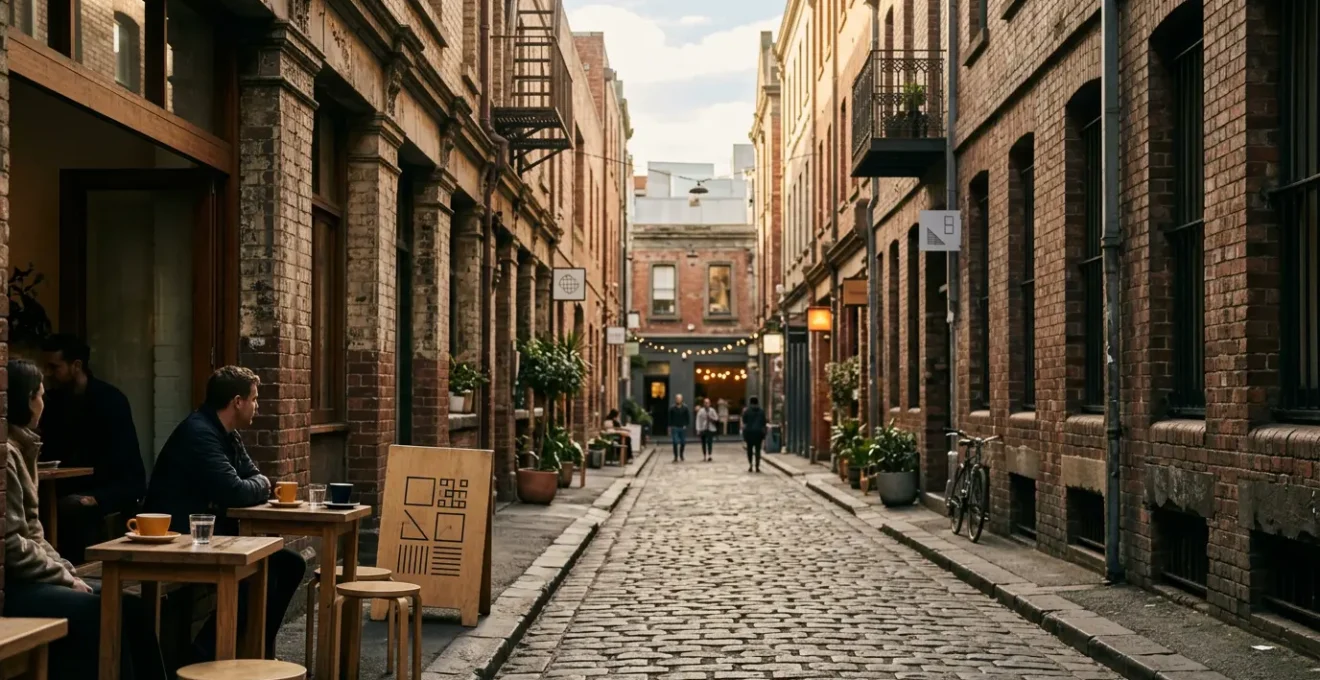
Forget everything you think you know about ordering coffee; in Melbourne, it’s a social performance, not a simple transaction.
- Your order is a social signifier that signals whether you’re a clueless tourist or a clued-in local.
- The city’s coffee scene is built on a specific economic model of high wages and independent ownership, which dictates everything from tipping to kitchen hours.
Recommendation: To fit in, you must learn to read the unwritten rules—from ordering a secret menu item like a ‘Magic’ to understanding why your lunch options disappear at 3 PM.
Walking into a Melbourne café can feel like stepping onto a stage without a script. The hiss of the espresso machine is the background track, the baristas are the lead actors, and a sea of locals seems to know all their lines. You see the familiar words—latte, cappuccino—but you sense a deeper code at play. The first rule everyone learns is simple: don’t you dare ask for a Starbucks. But that’s just the entry-level advice. It doesn’t explain the complex cultural and economic system that makes this city’s coffee scene a global benchmark.
This isn’t just about avoiding a soulless chain. It’s about understanding that your choice of drink, the time you order, the cup you use, and even the suburb you’re in are all social signifiers. In a city where 95% of over 1600 cafes are independently owned, coffee is a fiercely protected cultural institution. Ordering a venti caramel Frappuccino isn’t just a bad taste; it’s a fundamental misunderstanding of the local religion.
So, forget the generic travel tips. As a Melbourne barista, I’m here to give you the real script. We’re going to decode the unwritten menu, demystify the paying process, and explain the economic realities that shape your entire café experience. This is your guide to performing like a local, so you can stop being a spectator and finally get the best damn coffee of your life.
To navigate this complex world, we’ll break down everything you need to know, from secret menu items to the very real reasons you can’t get a hot meal mid-afternoon. Consider this your insider’s briefing.
Summary: Decoding Melbourne’s Coffee Code
- Magic vs Flat White: What Is the Secret Melbourne Menu Item?
- Table Service or Counter: How to Know Where to Pay in Australian Cafes?
- Fitzroy or Collingwood: Which Suburb Has the Highest Density of Roasters?
- Kitchen Closing Times: Why Can’t You Get Lunch at 3 PM?
- KeepCup Discounts: How Much Can You Save by Bringing Your Own Cup?
- Degraves Street vs Centre Place: Which Is the Real « Diagon Alley »?
- Modern Australian Cuisine: How Did « Mod Oz » Blend Asian and European Flavours?
- Exploring Melbourne Laneways: Which Hidden Bars Are Safe at Night?
Magic vs Flat White: What Is the Secret Melbourne Menu Item?
If you want to instantly signal that you’re in the know, don’t just order a flat white. While it’s our most famous export, the real insider’s choice is a ‘Magic’. This isn’t just a clever name; it’s a specific, off-menu order that acts as a password in the coffee community. Ordering one tells the barista you understand ratios, appreciate a stronger coffee-to-milk balance, and have graduated from the standard menu. A Magic is a double ristretto topped with steamed milk, served in a 5oz (approx. 150ml) cup. The ristretto shot is shorter and more concentrated than a standard espresso, resulting in a less bitter, more syrupy, and intensely flavourful coffee punch.

The drink reportedly originated at the iconic Brother Baba Budan cafe as a staff favorite before it became an unwritten part of Melbourne’s coffee lexicon. It’s for those who find a flat white a bit too milky but a long black too harsh. To order it correctly, simply ask for a « Magic. » Dropping the word « coffee » is part of the code. Don’t ask for it in a large size or with flavour syrups; that’s like asking for ketchup on a prime steak. The 5oz cup is non-negotiable, as it preserves the perfect, potent ratio that defines the drink. It’s the ultimate social signifier in a cup.
Table Service or Counter: How to Know Where to Pay in Australian Cafes?
The next test of your local knowledge comes at the end of your coffee: how do you pay? The confusion between table and counter service can be a dead giveaway of a tourist. But there’s a simple logic to it, and it’s tied directly to the economics of Australian hospitality. Unlike in the US, tipping is not expected or required. The reason is simple: staff are paid a proper living wage. Australia’s minimum wage for full-time workers is a robust $23.23 AUD per hour, with even higher « penalty rates » for weekends and evenings. The price you see on the menu is the price you pay, service included.
As one tipping culture expert from Lazy Gal’s Guide to Australia Tipping notes, this creates a different service dynamic:
Tipping is not a standard practice. Prices include service, and while a small tip for exceptional service is appreciated, it is not expected, unlike in the US.
– Australian tipping culture expert, Lazy Gal’s Guide to Australia Tipping
This economic reality often dictates the service style. Cafes with full table service (where staff take your order at the table) are essentially offering a premium experience and will typically let you pay at the counter on your way out. Cafes focused on high volume and efficiency will have you order and pay at the counter first. Learning to read the « spatial grammar » of a cafe is key.
Your Action Plan: Decoding the Cafe’s Service Style
- Check for menus on tables: If they are present and detailed, it’s likely table service where you pay at the end.
- Look for a visible queue at the register: If people are lining up and grabbing numbered table markers, it’s counter service.
- Observe the staff: If they are taking orders with notepads at tables, it confirms a table service model.
- Notice self-service stations: If there are carafes of water and condiment bars for self-serve, it strongly suggests a counter-order setup.
- Spot electronic buzzers or number stands: These are clear indicators of a counter-ordering system with food delivered to your table.
Fitzroy or Collingwood: Which Suburb Has the Highest Density of Roasters?
Choosing where you drink coffee is just as important as what you drink. The city’s northern suburbs, particularly Fitzroy and Collingwood, are the undisputed heartland of Melbourne’s coffee scene, but they offer distinctly different experiences. It’s not about which has more roasters per square metre, but which « personality » suits you. Think of them as two rival siblings: both brilliant, but with entirely different styles.
Coffee Suburb Personalities: A Tale of Two Neighbours
Fitzroy is the established, bohemian heartland. It’s home to iconic roasters like Industry Beans, housed in stunning, architecturally designed warehouses. The vibe is more refined, with curated brunch menus and sun-drenched spaces. It’s polished and confident. In contrast, Collingwood is its edgier, industrial-chic sibling. It’s home to experimental powerhouses like Proud Mary and Aunty Peg’s, which operate out of heritage buildings as multi-level roasteries, cafes, and training facilities. As a Broadsheet guide points out, Collingwood embraces gritty, experimental innovation while Fitzroy leans toward a more curated, established experience.
But a true coffee aficionado knows the scene extends far beyond this famous duo. Limiting yourself to Fitzroy and Collingwood is like visiting Paris and only seeing the Eiffel Tower. Each suburb has its own coffee dialect:
- Brunswick: Student-friendly and alternative, with diverse international coffee influences and affordable, experimental cafes.
- South Melbourne: Caters to market-goers and professionals with established roasters and excellent grab-and-go options.
- Richmond: A fusion of post-footy crowds and a strong Vietnamese coffee culture, famous for its robust iced coffee.
- Carlton: The university precinct and spiritual home of the Third Wave movement, with historic institutions like Seven Seeds.
- West Melbourne: The domain of large-scale warehouse roasteries like Five Senses Coffee, focusing on direct trade relationships.
Kitchen Closing Times: Why Can’t You Get Lunch at 3 PM?
You’ve navigated the menu and the suburbs, but now you face another uniquely Melbourne puzzle: the 3 PM « hunger gap. » Tourists are often baffled when they walk into a bustling cafe at 2:45 PM, only to be told the kitchen is closed. This isn’t laziness; it’s a direct consequence of the city’s cafe business model and a cultural emphasis on work-life balance for hospitality staff. It all comes down to economic viability.
With high minimum wages and penalty rates, labour is a cafe’s biggest expense. Australian cafe industry benchmarks show that labor costs must stay between 30-35% of sales for the business to be profitable. The typical Melbourne cafe rhythm is predictable: a pre-work rush (7-9 AM), a mid-morning lull, a massive lunch crunch (12-2 PM), and then a steep drop-off in foot traffic. Keeping a full kitchen staff on during the quiet mid-afternoon is simply not sustainable. So, most cafes switch to a coffee-and-cake-only service around 2:30 or 3:00 PM to control costs.
This isn’t a flaw in the system; it’s the system working as designed. It ensures staff are paid well and businesses can survive. The key is to adapt your own schedule to this rhythm. To avoid the hunger gap, a savvy local employs a few key strategies:
- Target bakeries like the famous Lune Croissanterie for world-class afternoon pastries.
- Seek out cafes that explicitly advertise an « all-day menu » on their signage or online listings.
- Explore Vietnamese bakeries in suburbs like Richmond or Footscray for Banh Mi, which are typically available all day.
- Plan your main meals to align with the city’s service patterns: lunch before 2 PM and dinner after 6 PM.
- Always check Google Maps for a cafe’s hours before you go; many close entirely by 3 or 4 PM.
KeepCup Discounts: How Much Can You Save by Bringing Your Own Cup?
In Melbourne, your coffee cup is another potent social signifier. Walking in with a disposable cup is acceptable, but arriving with your own reusable cup—especially a KeepCup, a brand born right here in Melbourne—signals that you’re part of the culture. It shows you care about sustainability and respect the quality of the coffee enough not to taint it with paper. And beyond the social brownie points, there’s a tangible financial benefit.
Bringing your own cup will almost always get you a discount. It’s a small thank you from the cafe for saving them the cost of a disposable cup and lid. The standard discount varies, but you can generally expect to save between 50 cents to $1 AUD per coffee. If you’re a daily coffee drinker, that adds up quickly, saving you over $250 a year. This practice is deeply embedded in the culture, a small daily ritual that reinforces the community’s shared values of quality and environmental consciousness.
This widespread adoption of reusable cups is another ripple effect of the city’s independent cafe scene. Unlike global chains that rely on standardized, branded disposables for marketing, Melbourne’s indie cafes are run by passionate owners who are more focused on the quality of what’s *in* the cup. They are happy to encourage a practice that reduces waste and puts the focus back on the coffee itself. It’s a small but powerful symbol of the city’s collective coffee philosophy: substance over branding, quality over convenience, and community over corporation.
Degraves Street vs Centre Place: Which Is the Real « Diagon Alley »?
Melbourne’s laneways are the veins of the city, and for many, they are the most memorable part of its coffee culture. Degraves Street and its narrow offshoot, Centre Place, are often the first stop for visitors, earning the nickname « Diagon Alley » for their bustling, hidden-world atmosphere. But just like Fitzroy and Collingwood, these two laneways offer very different experiences, rooted in the history of Melbourne’s urban revival.
These alleys were originally grungy service lanes for the main city grid. In the late 1980s and 1990s, a visionary urban renewal project transformed them from forgotten back-alleys into the vibrant cultural hotspots they are today. Degraves Street emerged as the more polished, Parisian-inspired artery, with its wide-set tables perfect for al fresco dining and people-watching. It feels curated and established. Centre Place, on the other hand, retained a grittier, more chaotic energy. It’s narrower, crammed with tiny hole-in-the-wall vendors, and covered in a dense layer of street art. It feels more spontaneous and « discovered. »
Neither is more « authentic » than the other; they simply cater to different moments. Knowing when to go where is part of the local’s ‘spatial grammar’:
- Degraves Street (Morning, 7-10 AM): Ideal for a seated breakfast and coffee, watching the city’s pre-work rush unfold.
- Centre Place (Lunchtime, 12-2 PM): Perfect for a quick, standing-room-only coffee and a grab-and-go bite from one of its many tiny kitchens.
- Hardware Lane (Evening, 6-9 PM): Transforms into a European-style dining strip with live music and a completely different atmosphere.
- Degraves Street (Afternoon, 3-5 PM): When kitchens have closed, it becomes a prime spot for a coffee-only break and prime people-watching.
Modern Australian Cuisine: How Did « Mod Oz » Blend Asian and European Flavours?
You can’t fully understand Melbourne’s coffee without understanding its food. The two are inseparable, both shaped by the same powerful force: waves of immigration. The city’s famous brunch culture and its signature « Modern Australian » (or « Mod Oz ») cuisine are a direct reflection of this history. It started with the post-war arrival of Italian and Greek immigrants, who brought the first espresso machines in the 1950s and laid the foundation for our coffee obsession.
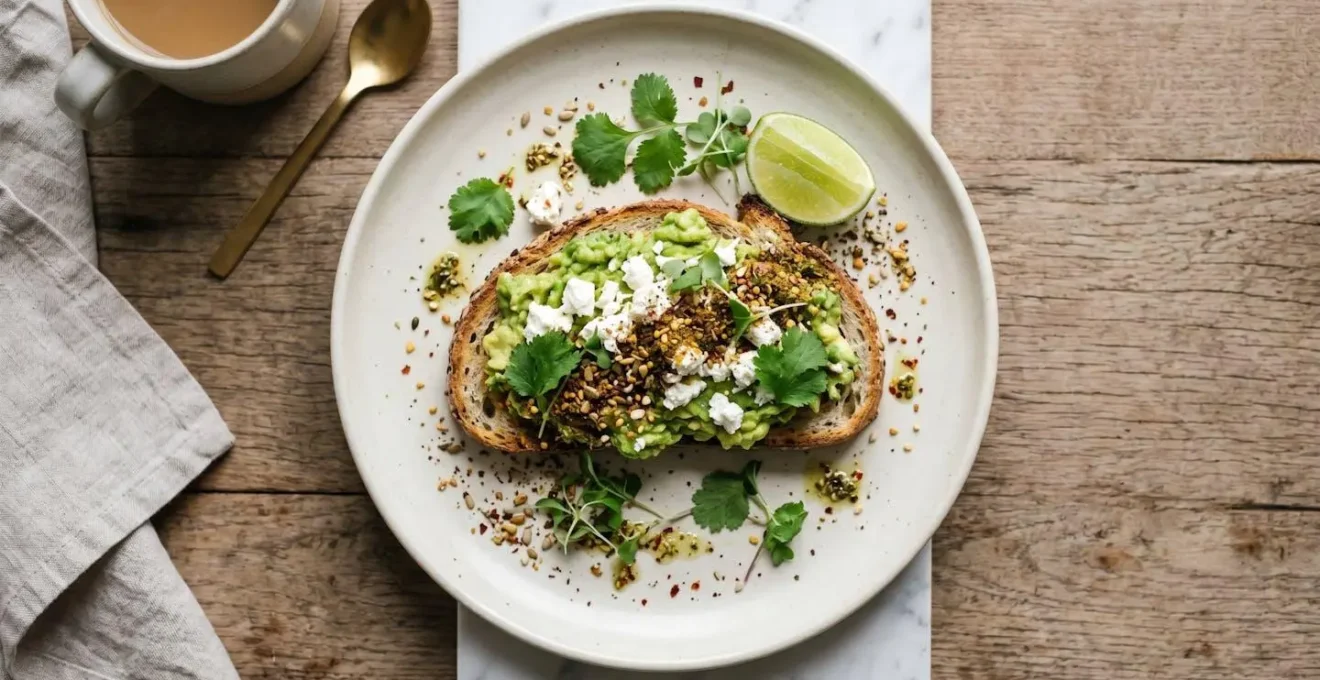
Subsequent waves of immigration, particularly from Asia (Vietnam, Thailand, China) and the Middle East, added new layers of flavour and technique. « Mod Oz » isn’t a contrived fusion; it’s an organic culinary dialogue that happened on the plate. It’s about applying European techniques to Asian ingredients, or adding a Middle Eastern twist to a classic British dish. The quintessential Melbourne brunch dish, smashed avocado on sourdough, is a perfect example: sourdough toast (European) topped with avocado, feta (Greek), dukkah (Middle Eastern), and a squeeze of lime (Asian). It’s multiculturalism on a plate.
This culinary blending is evident on every cafe menu in the city. When you visit, look for these classic Mod Oz dishes that tell the story of modern Australia:
- Corn fritters with chili jam: A European fritter tradition given a spicy, sweet kick from Asian flavours.
- Ricotta hotcakes with honeycomb butter: Italian dairy meets a classic Australian ingredient.
- Chilli scrambled eggs: A British breakfast staple, completely reimagined with the heat and complexity of Asian spices.
- Turmeric or matcha lattes: The integration of traditional Asian health ingredients into the European cafe format.
Key Takeaways
- Melbourne’s coffee culture is an economic and social system, not just a set of drinks. High wages mean no tipping, and dictate kitchen hours.
- Your coffee order is a social signifier. Ordering an off-menu « Magic » proves you’re an insider.
- The city’s geography matters. The personality of suburbs like Fitzroy and Collingwood, and the specific use of laneways like Degraves Street, are part of the code.
Exploring Melbourne Laneways: Which Hidden Bars Are Safe at Night?
As day turns to night, Melbourne’s coffee-centric DNA doesn’t disappear; it just evolves. The same laneways that house your morning flat white become the backdrop for your evening cocktail, and nowhere is this more evident than in the city’s obsession with the Espresso Martini. This cocktail is the perfect symbol of Melbourne’s dual passions: third-wave specialty coffee and innovative mixology. The best laneway bars partner with local roasters, using single-origin beans to craft cocktails with the same precision and care that define the daytime coffee scene.
For a visitor, navigating these laneways at night can be intimidating. Are these dark alleys safe? Generally, yes. The laneways that are active at night are very safe, but it’s crucial to distinguish between a vibrant « eat street » and a deserted service alley. Use this as your guide:
- Main ‘eat streets’ (e.g., Hardware Lane, Degraves Street): Very safe until late due to constant foot traffic from restaurants and well-lit establishments.
- Laneway bar strips (off Little Collins or Bourke Street): Safe when bars are open (typically 6 PM until late), often with security staff present.
- Arts laneways (e.g., Hosier Lane): Generally safe in the early evening but can become empty and less monitored after 10 PM.
- Pure service alleys: Avoid these at night. If there are no open businesses, lights, or foot traffic, there’s no reason to be there.
The golden rule is to follow the crowds and the light. A busy, well-lit laneway is the city’s living room. A dark, empty one is just a shortcut for delivery trucks. Sticking to the populated areas ensures your exploration of Melbourne’s nightlife is as safe as it is exciting.
So, step away from the chains, walk into that crowded laneway cafe with your KeepCup in hand, and order with confidence. Your perfect Melbourne coffee experience isn’t just about finding a good brew; it’s about earning it. Now you have the script. Go and perform.